
The right tip for your material
Special buckets and grabs
“The bucket will not go in, or it wears out in weeks”
When what falls short is not the machine but the tip: rock, cleaning, skeleton, clamshell or orange-peel — sized against the material and against your machine's stability, not against a catalog.
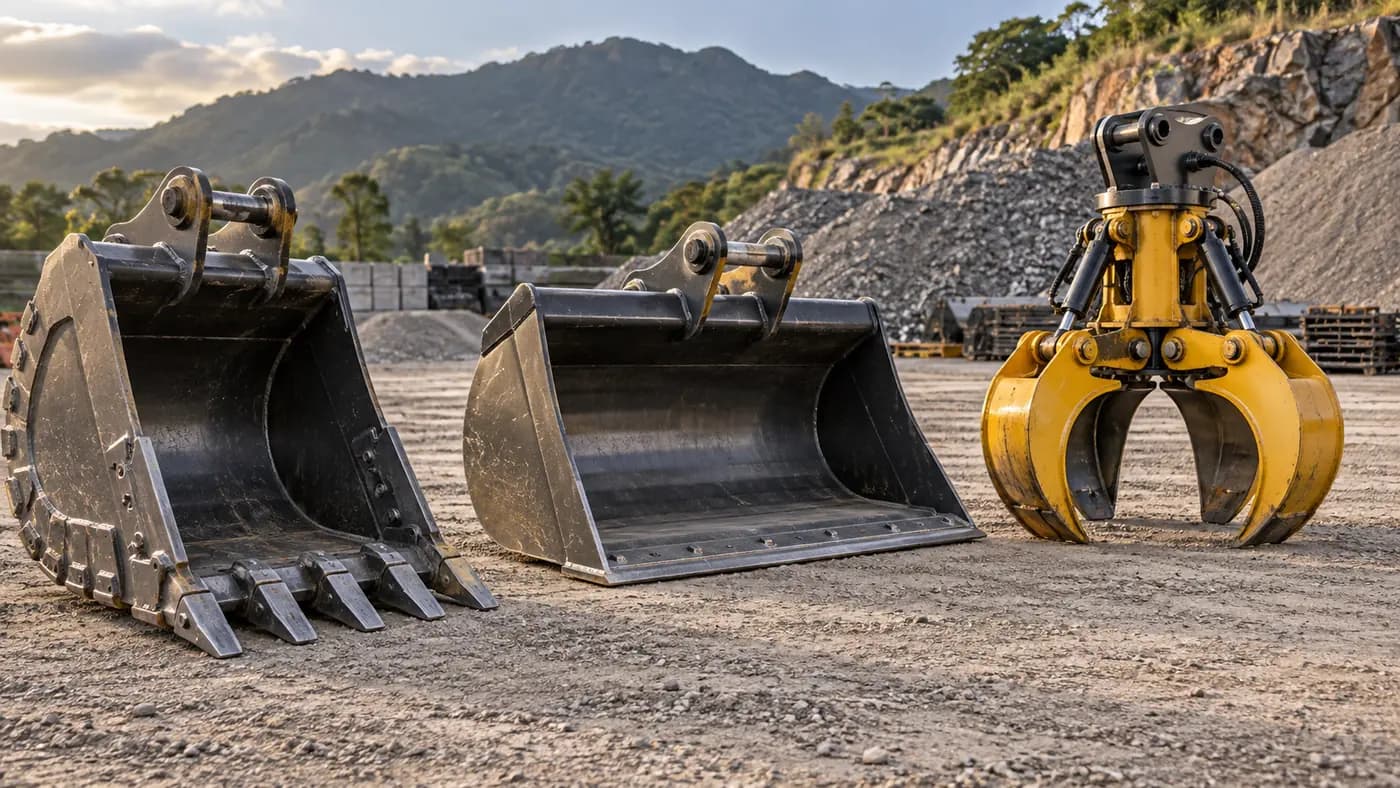

Where it is used
The jobs it solves
- Blasted rock and abrasive material
- Canal cleaning and profiling
- On-site screening and separation
- Log, scrap and waste handling
Size is calculated against the material's real density AND your machine's stability: the same volume of rock weighs far more than soil.
How it is actually chosen
A bucket is not chosen by cubic metres
It is chosen by the weight of what you are moving. Two things decide the size: how much a cubic metre of your material weighs (its density) and how much of the bucket actually fills. Multiplied together, they change the answer by up to double.
A bucket of 1.0 m³ in
Wet sand and gravel
2.02 t
2.02 t/m³ × 100 % fill factor
A bucket of 1.0 m³ in
POORLY fragmented rock
0.72 t
In the bank 2.8 t/m³ · loose 1.6 · fills 45 %
It is the same bucket. Rock weighs 2.8 t/m³ in the bank; once blasted it swells to 1.6 and, poorly fragmented, fills less than half the bucket: it ends up carrying a third of what wet sand does. That is why asking for "one cubic metre" says nothing on its own.
| Material | Densityt/m³ | Fills to | Real loadper pass · 1 m³ | What to ask for |
|---|---|---|---|---|
| Wet sand and gravelRiverbed, borrow pits in the rainy season | 2.02 | 100 % | 2.02 t | Less volume |
| Dry sand and gravelBorrow pits, dry season | 1.72 | 100 % | 1.72 t | Standard or one size down |
| Mud and saturated soilShrimp farms, drainage, canals | 1.6 | 105 % | 1.68 t | Less volume |
| Common earthGeneral construction, developments | 1.4 – 1.6 | 100 % | 1.50 t | Factory standard← the factory one |
| Iron oreMining | 2 | 65 % | 1.30 t | Minimum volume · extreme duty |
| SaltSalt flats, ports | 1.3 | 100 % | 1.30 t | More volume |
| Hard, compacted clayEarthworks in the dry season | 1.45 | 85 % | 1.23 t | Less volume + penetration |
| WELL-fragmented rockQuarry with good blasting | 1.6 – 1.8 | 70 % | 1.12 t | Less volume · extreme duty |
| Topsoil (stripping)Start of works: the organic layer | 0.95 | 100 % | 0.95 t | More volume |
| CoalPower yards, cement plants | 0.55 – 1.0 | 100 % | 0.80 t | More volume |
| POORLY fragmented rockQuarry with poor blasting | 1.6 | 45 % | 0.72 t | Minimum volume · extreme duty |
| Loose scrapRecycling, scrap yards | 0.6 – 1.2 | 60 % | 0.54 t | Grab or high volume |
| Wood chip · biomassSawmills, biomass boilers | 0.3 – 0.4 | 95 % | 0.33 t | Much more volume |
| Sugarcane bagasseSugar mills | 0.15 | 100 % | 0.15 t | Nearly double the volume |
Loose reference densities from Komatsu's Specifications & Application Handbook; salt, scrap, wood chip and bagasse are general references. Confirm your material's real density by weighing: fill the bucket, weigh the load and divide by the volume. The factory bucket is configured for ~1.5 t/m³ — common earth.
This is how Komatsu solves it at the factory. The WA320-6 bagasse loader carries a 5.0 m³ bucket instead of 2.7 m³: with material this light, nearly doubling the bucket nearly doubles what it moves per pass.The other decider: penetration
In hard material you are not short of force, you are long on width. A narrower bucket concentrates the same force on less edge and gets in.
- Bucket width
- Hard: Narrower → more penetrationLoose: Wider → more volume per pass
- Radius to the tooth tip
- Hard: Shorter → more breakout forceLoose: Longer → reaches and loads more
The brochure's cubic metre is heaped
The capacity in the brochure is HEAPED: the volume level with the rim plus the heap the material holds on top. That heap is measured at a 1:1 angle of repose for excavator buckets and 1:2 for loader buckets. Comparing two buckets without knowing which standard measured them is comparing apples to oranges — and it is why 'the same cubic metre' sometimes performs differently.
With the material, the machine model and the hours per day we tell you which bucket to ask for — and whether extreme-duty or simply bigger is the right call.
It arrives as one machine, with one point of responsibility
A single point of responsibility
The base machine, the special configuration and the commissioning arrive as one machine delivered by the group. No finger-pointing between suppliers when something fails.
Local support for the base machine
It is a Komatsu: parts, workshop and certified technicians in El Salvador, Guatemala, Nicaragua and Panama, with the same KOMTRAX telematics as the rest of the fleet.
Sized against the project
Reach, depth and soil type govern, not a catalog. It is defined in a technical visit and quoted against the real job, not against a list of options.
Other configurations
Long-reach excavator
Reach without entering the water
Amphibious excavator
Where a standard undercarriage sinks
Forestry and timber handling
From the bush to the log yard
High-reach demolition
Taking the structure down without taking the machine down
Material and scrap handling
Seeing inside the container
Pedestal boom system
The machine that doesn't move
Tell us the job, not the machine
What has to be moved, at what depth, over what ground and for how long. With that we define the base machine and the configuration, and the proposal comes back against the real job.
Request a technical visit