Skip to content
Grupo ConstruMarket

Special solutions · Komatsu

When the job is beyond a catalog machine

Some jobs the catalog machine simply cannot do: cleaning a canal from the bank, moving over mud, working inside a shrimp pond, demolishing at height or handling scrap in a yard. For those, the Komatsu excavator is configured to the project and delivered as one machine, backed by the group's parts and workshop.

The two most asked for

Long reach and amphibious

These are the two we are asked for most and the ones we have already delivered in the region — not a factory catalog we are trying out.

Reach without entering the water

Long-reach excavator
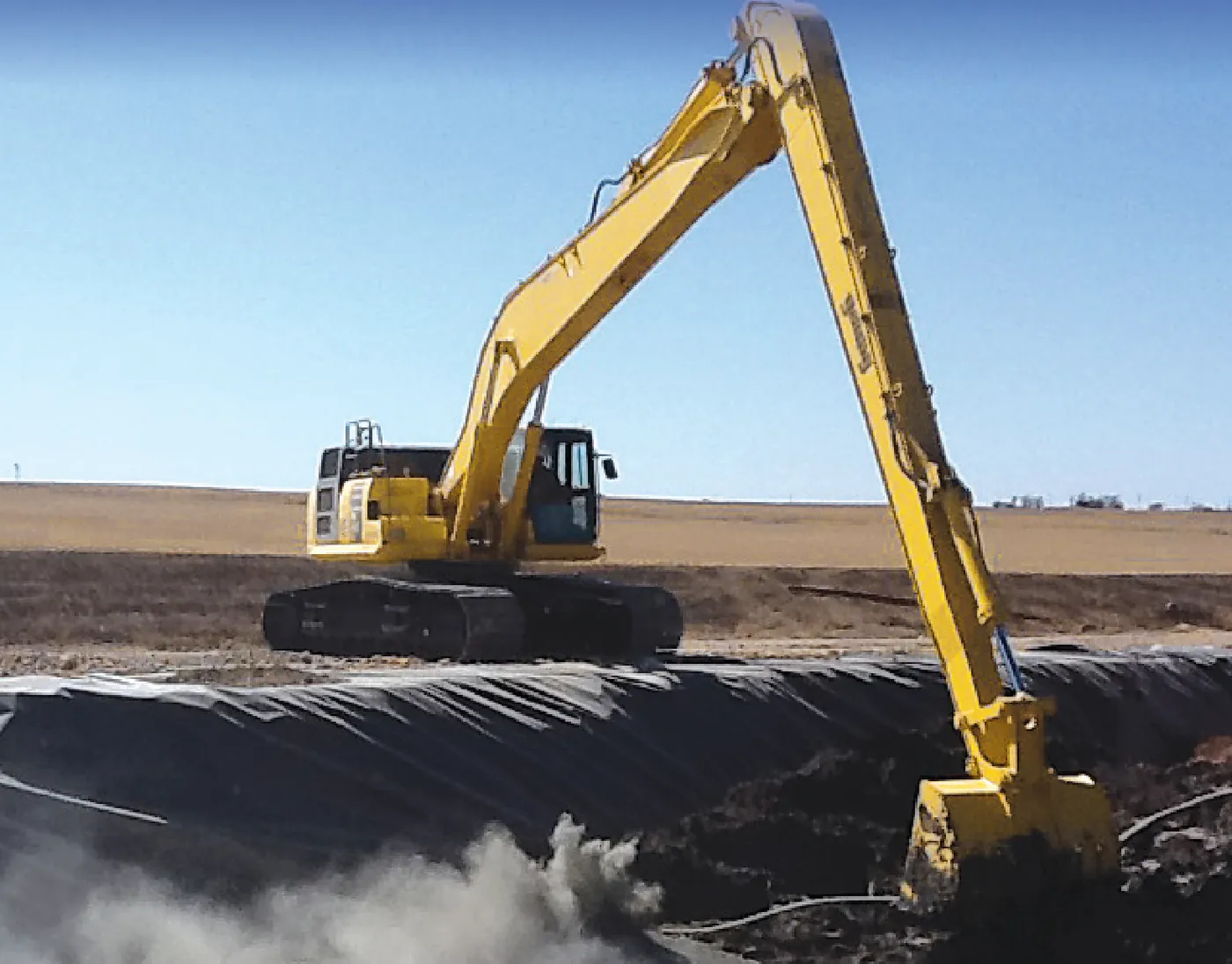
Komatsu excavator with Super Long Front working from firm ground over a lined pond, without entering the water

The Super Long Front is not an arm bolted onto a catalog machine: it is a Komatsu factory arrangement, built from the frame up. It carries additional factory counterweight, frame reinforcement and optimized hydraulics to hold that reach without compromising the machine's balance. It goes on the PC210LC-10, PC240LC-10, PC290LC-10, PC360LC-10, PC390LC-10 and PC490LC-10, with fronts from 15.2 to 19.8 metres. The arm tucks under the boom so the machine transports without dismantling the front.

Front length
15.2 – 19.8 m
Max digging reach
15,240 – 19,812 mm
Max digging depth
11,506 – 14,072 mm
Base machines
PC210LC-10 → PC490LC-10
  • Rehabilitation of waste and settling ponds in plants
  • River and creek bank maintenance and stabilisation
  • Dredging of waterways and bridge foundations
  • Irrigation and drainage ditch maintenance
  • Highway sloping and landscaping
  • Cofferdam and slurry-wall construction in light soils
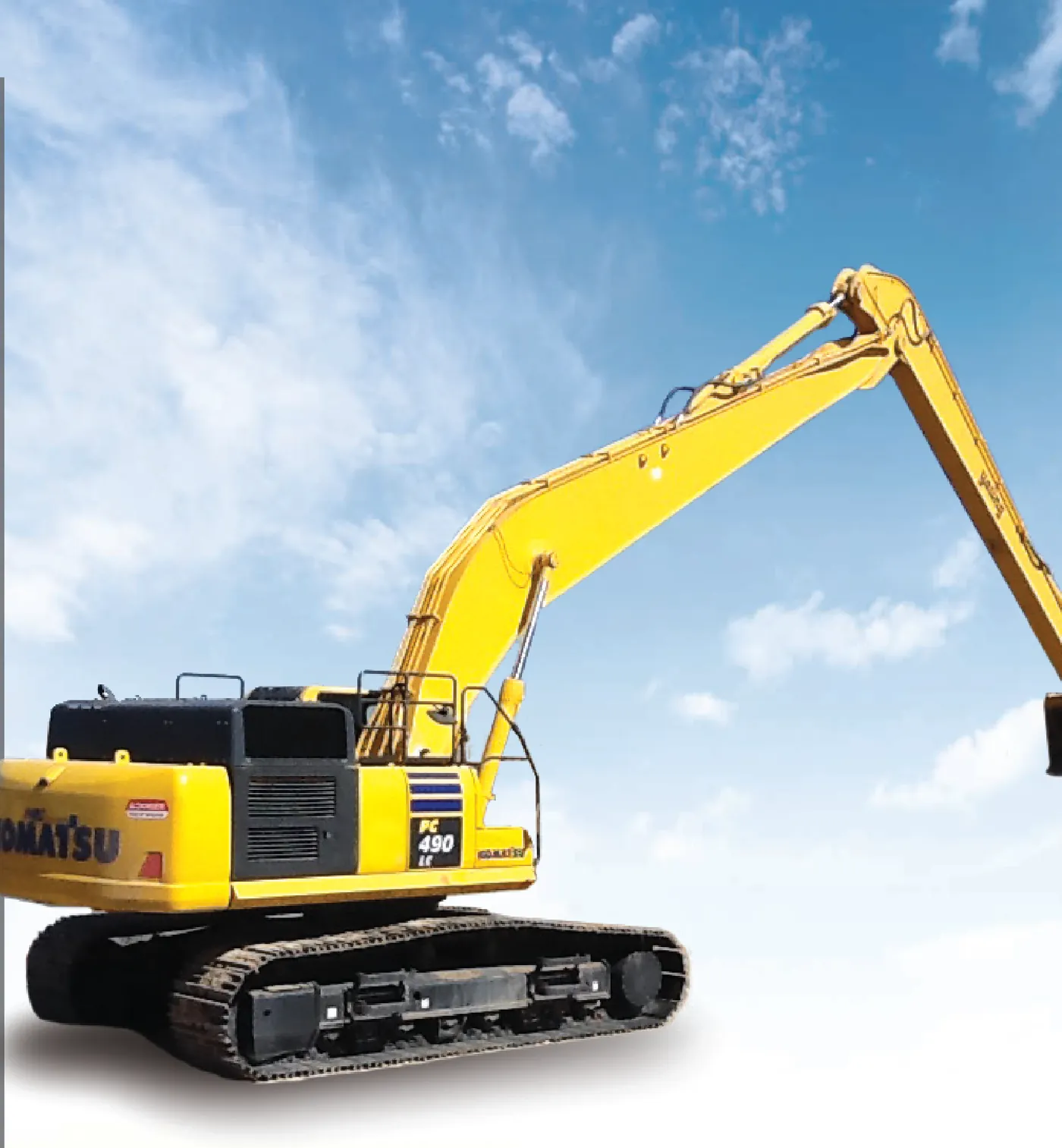
Komatsu PC490LC-10 with the factory Super Long Front arrangement, full machine viewOfficial Super Long Front working-range diagram: horizontal reach and digging depth by model

A long front trades breakout force for reach: the front is sized against the project's actual depth and material, not the other way round. The ranges below are factory catalog figures — the reach that applies to your site comes out of the technical visit.

Where a standard undercarriage sinks

Amphibious excavator

A pontoon undercarriage that spreads the machine's weight over a far larger footprint: the excavator floats and moves across mud, mangrove and saturated ground where a conventional track sinks on day one. It combines with a long front when the work is also far from the bank, and with an amphibious carrier when the spoil has to leave the working face.

  • Shrimp ponds: building, cleaning and maintaining pond walls
  • Wetlands, mangroves and estuaries
  • Irrigation and drainage canals on saturated ground
  • Work on flooded areas and river margins

The configuration depends on the site's soil type and water depth: it is defined in a technical visit before quoting.

Made to order

And the ones built against the project

These configurations are not on the shelf: they are quoted to order against the job in front of you. Tell us what has to be moved and where, and we will tell you which base machine and configuration takes that duty cycle.

  • Forestry and timber handling

    A whole family, not one attachment: an elevated and tilting cab to see the work face, structural guarding, forestry boom, grapple, felling head or processor — and a specific configuration when the ground is steep.

  • High-reach demolition

    A high-reach demolition front with reinforced guarding and the right tool — pulveriser, shear or breaker — on a base sized to take the duty cycle. Vertical reach is defined by the real height of what has to come down.

  • Material and scrap handling

    Yard configuration: a material-handling boom, an elevating cab so the operator can see into the container, and a grapple or magnet depending on what is moved. It changes the whole machine, not just the tip.

  • Pedestal boom system

    The excavator without an undercarriage, fixed on a base beside the crusher, the hopper or the grizzly. It breaks the blockage without tying up a mobile machine or putting anyone at the feed opening — and works the whole shift from one point.

  • Amphibious carrier

    Hauling for ground no truck can enter: a pontoon platform that moves the material the amphibious excavator digs out. Without it, the amphibious machine digs and the spoil stays where it fell.

  • Underground mining

    A low-profile build for working in a drift, with the guarding and overall height the tunnel section allows. Here the constraint is not force: it is how tall the machine is.

  • Special buckets and grabs

    When what falls short is not the machine but the tip: rock, cleaning, skeleton, clamshell or orange-peel — sized against the material and against your machine's stability, not against a catalog.

  • Pile driving

    An excavator base adapted for deep foundation work with a vibratory or impact hammer, with the stability and flow that work requires.

Why through us

It arrives as one machine, not as parts from three suppliers

  • A single point of responsibility

    The base machine, the special configuration and the commissioning arrive as one machine delivered by the group. No finger-pointing between suppliers when something fails.

  • Local support for the base machine

    It is a Komatsu: parts, workshop and certified technicians in El Salvador, Guatemala, Nicaragua and Panama, with the same KOMTRAX telematics as the rest of the fleet.

  • Sized against the project

    Reach, depth and soil type govern, not a catalog. It is defined in a technical visit and quoted against the real job, not against a list of options.

Frequently asked questions

What is a long-reach excavator and when is it worth it?

It is an excavator with an extended front (Super Long Front) to reach the bottom of a canal, lagoon or deep slope from firm ground, without putting the machine in the water or building a temporary access road. It pays off when the cost and risk of that access road exceed the cost of configuring the machine. It trades breakout force for reach, so the front is sized against the project's real depth and material.

What is an amphibious excavator and how does it differ from a standard one?

It runs on a pontoon undercarriage instead of conventional tracks: it spreads the weight over a far larger footprint, so it floats and moves across mud, mangrove and saturated ground where a standard track sinks on day one. It is the machine for shrimp ponds, wetlands and irrigation canals in soft soil. It combines with a long front when reach is also needed.

Are warranty and service the same as a catalog Komatsu?

The base machine is a Komatsu: parts, workshop and certified technicians in El Salvador, Guatemala, Nicaragua and Panama, with the same KOMTRAX telematics. The special configuration is delivered by the group as part of the same machine, so there is one point of responsibility and no finger-pointing between suppliers when something fails. The exact scope of coverage is defined in the quotation.

How much does it cost and how long does it take?

There is no price list because no two projects are alike: reach, depth, soil type and the attachment all change the configuration, and with it the cost and the lead time. The first step is a technical visit to the site; that produces a proposal with a real scope.

Tell us the job, not the machine

What has to be moved, at what depth, over what ground and for how long. With that we define the base machine and the configuration, and the proposal comes back against the real job.

Get a quote