Short answer
A lay-in ceiling is a suspended ceiling of tiles or trays that rest on a visible grid: each piece lifts out by hand to reach the services above. Choose it when you need frequent access to ducts, cables and lights. Among the types, decide by acoustics (NRC), the room's humidity and the look: mineral fiber for dry interiors, metal where there's humidity or you want a more durable finish.
What a lay-in ceiling is and how it works
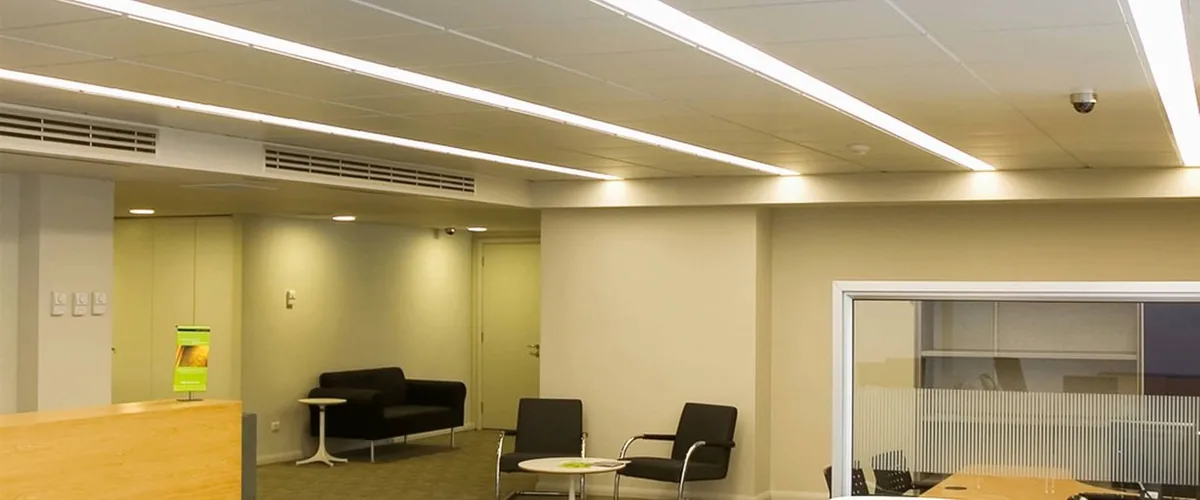
«Lay-in» means the tiles are laid on top: a T-bar grid hangs from the slab on hangers and the tiles rest on it, without screws. Between the slab and the ceiling is the plenum, where air-conditioning ducts, cabling, piping and sprinklers run. That's its biggest advantage: to check a leak or run a cable you lift the tile and put it back.
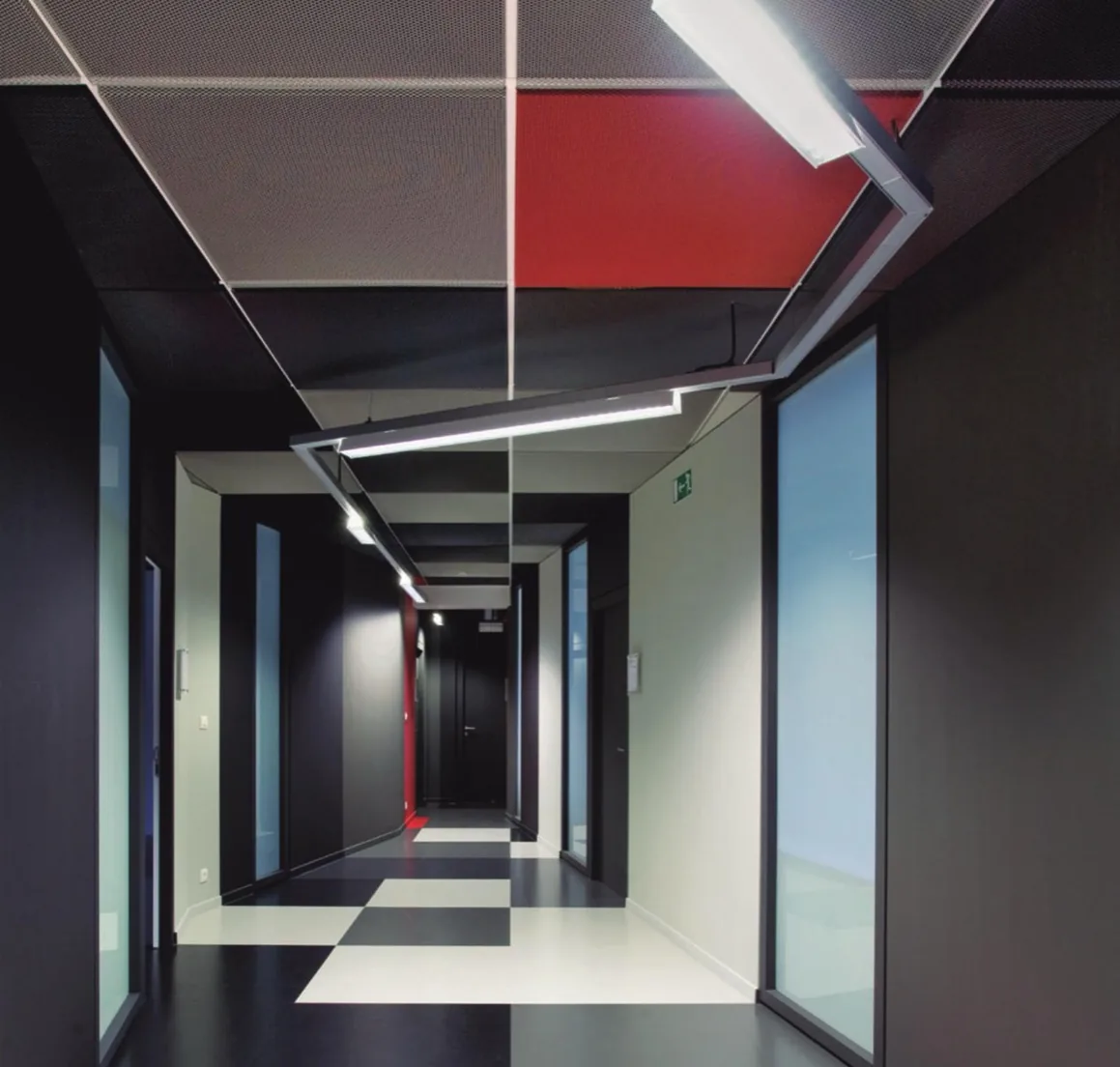
Hunter Douglas describes its Tile Lay-In as a suspended modular tray ceiling with a maximum-accessibility suspension system: the grid stays visible, forming a square pattern that frames the surface, and the tray can be plain or perforated, in several colors.
- Slab: Building structure
- Hangers: Suspend the grid
- Plenum: Ducts, cables, piping
- T-bar grid: Visible profiles
- Tiles or trays: Lift out by hand
Types of lay-in: mineral fiber or metal
The mineral-fiber tile, known in the region as «American ceiling», is the most common in offices. The Hunter Douglas catalog has several: Ultima, with a smooth, washable finish resistant to impacts and scratches, Class A fire rating; Fashiontone, micro-perforated, with 45% NRC, 30 dB CAC and 80% light reflectance; Cortega, with a medium fissured texture, and Clean Room VL, with a factory vinyl membrane, suitable for clean rooms up to ISO Class 5 and CAC 35 to 40 sound blocking.
Metal lay-in uses metal trays. According to Hunter Douglas, the Tile Lay-In reaches an NRC of 40% to 95% with perforation and an acoustic blanket, has a Class A fire rating under ASTM E84 and replaces mineral tiles without changing the grid. Its Tile Lay-In Metal · MetalScreen version uses expanded mesh with 19% open area: a translucent ceiling that hides the plenum without closing it off.

Lay-in, snap-in or linear: how they differ
Lay-in isn't the only accessible ceiling. Hunter Douglas's Tile Snap-in uses concealed suspension: the trays snap in and leave a uniform 6 mm reveal, for a smooth ceiling without a visible grid; it's still accessible and has 40% to 80% NRC with a perforated tray and membrane. The 84R Linear Ceiling uses panels 84.5 mm wide and up to 5,000 mm long on a carrier, removable without tools, with 40% to 95% NRC according to the manufacturer. And the Plank Hook-on gives a monolithic look; thanks to its profiles it resists wind and also works outdoors.
| Criterion | Tile Lay-In | Tile Snap-in | 84R Linear |
|---|---|---|---|
| Suspension | Visible grid | Concealed | Carrier |
| Plenum access | Maximum | Accessible | Tool-free |
| NRC with perforation | 40% to 95% | 40% to 80% | 40% to 95% |
| Look | Square grid | Smooth, 6 mm reveal | Continuous lines |
Acoustics: what NRC is and how much you need
NRC (noise reduction coefficient) tells you what share of the sound reaching the ceiling is absorbed instead of bouncing back. It runs from 0 to 1, or 0 to 100%: an NRC of 0.70 absorbs about 70%. The higher it is, the less echo and background noise. CAC is something else: it measures how much sound the ceiling blocks between two rooms sharing the plenum, and it matters in private offices and meeting rooms.
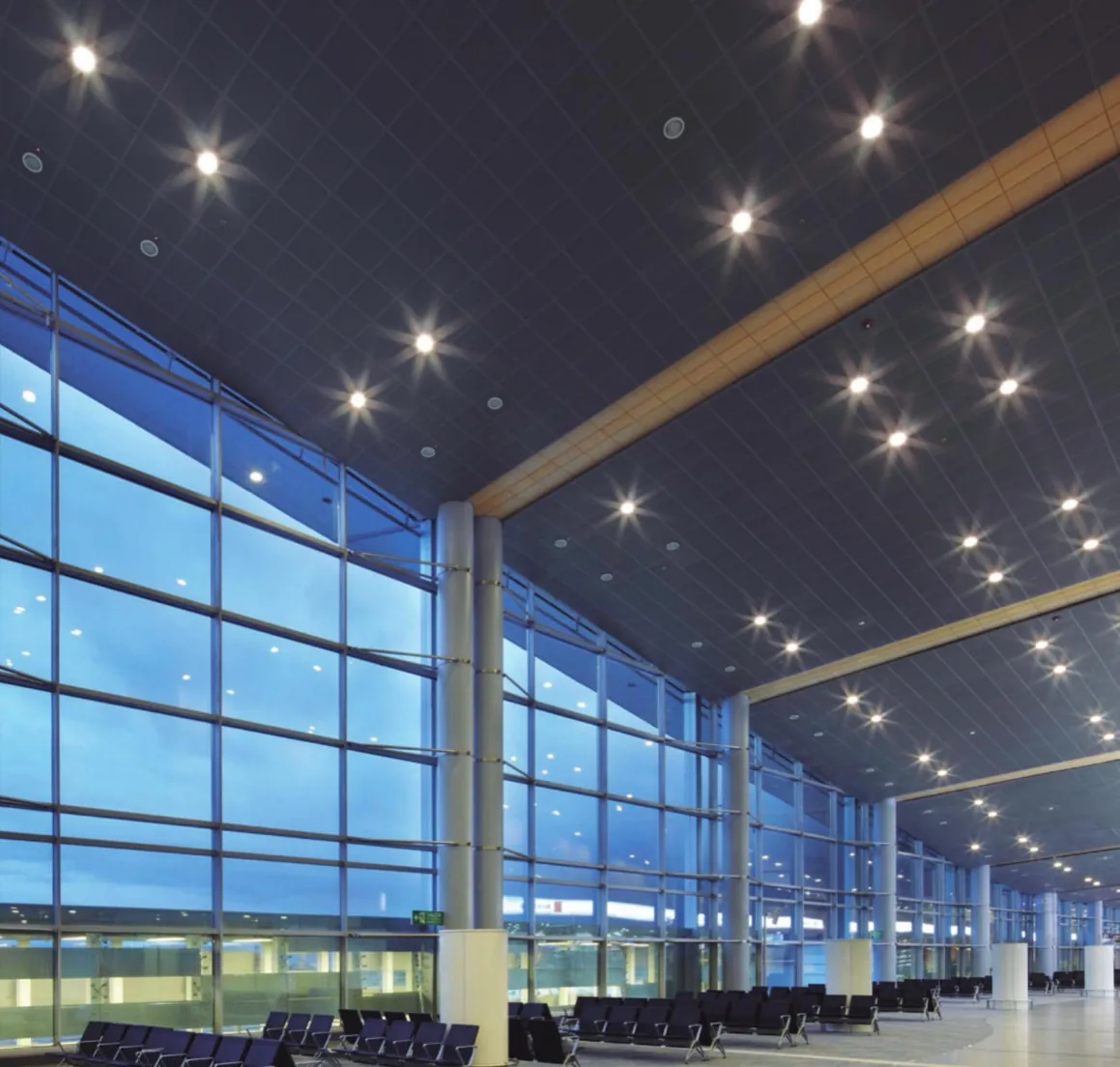
As a rule: open offices, call centers, classrooms and dining halls need high NRC; corridors and storage, less. In a metal ceiling, NRC rises with perforation and the acoustic blanket, so ask for the exact combination when quoting. For spaces with an exposed slab, Acoustic Clouds (suspended islands with a Serge Ferrari membrane, NRC 0.65) and HeartFelt (polyester felt panels, 40% to 95% NRC) add absorption without closing the whole ceiling.
- Plank Hook-on: 100 % NRC
- Tile Lay-In: 95 % NRC
- HeartFelt: 95 % NRC
- Tile Snap-in: 80 % NRC
- Baffle: 70 % NRC
- Acoustic Clouds: 65 % NRC
- Fashiontone: 45 % NRC
- Source: Hunter Douglas datasheets (maximum with perforation and acoustic infill)
Humidity, climate and outdoors
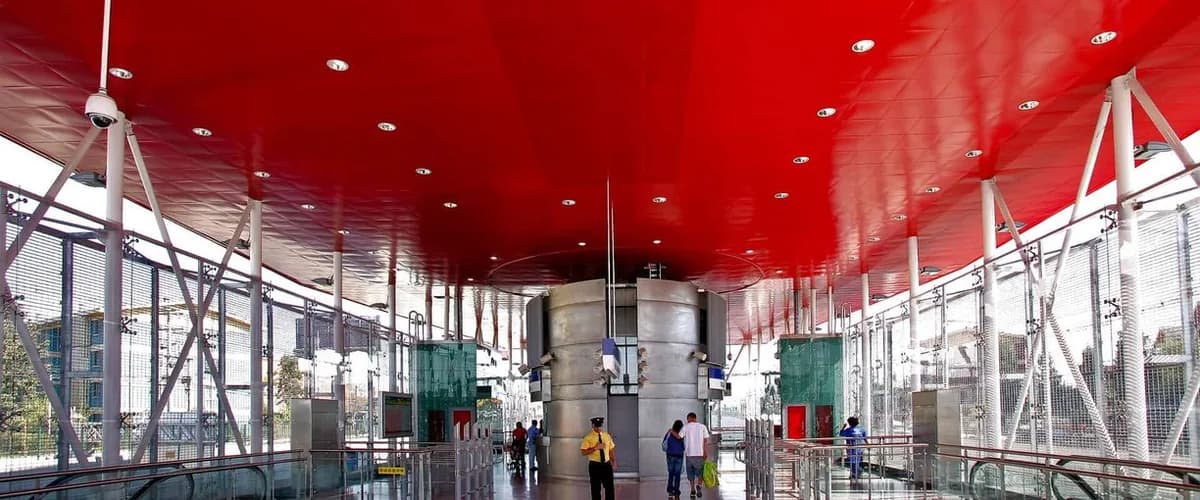
In Central America's climate, humidity decides more than it seems. Common mineral-fiber tiles can sag or stain under sustained high humidity, for example in spaces without air conditioning, near the sea or with slab leaks. If the space isn't climate-controlled or is semi-outdoor, prefer a metal ceiling. For eaves, open corridors and outdoors, Hunter Douglas specifies the Plank Hook-on, whose profiles resist wind. For clean rooms or areas that are washed, the Clean Room VL tile has a vinyl membrane and is washable.
Lights, air conditioning and earthquakes
A lay-in ceiling is designed together with everything that goes in it. Before ordering, have the reflected ceiling plan with lights, air-conditioning diffusers and grilles, sprinklers, smoke detectors and speakers, all coordinated with the grid module. Recessed lights must match the tile module; confirm the system's module with the advisor. Heavy items, like light fixtures and equipment, should hang from the slab with their own support instead of loading the grid.
Central America is a seismic zone. Hunter Douglas has Seismic Ceiling Systems, designed under the IBC for seismic categories D, E and F, with seismic clips and lateral bracing that keep edge panels from falling in an earthquake. Ask for them in hospitals, schools, public buildings and anywhere with many people.
Where to get a quote for Hunter Douglas ceilings
Grupo ConstruMarket is Hunter Douglas's authorized distributor in El Salvador, Guatemala (CMARKET), Nicaragua and Panama, with the full ceiling line: mineral-fiber and metal lay-in, snap-in, linear, baffles, acoustic clouds and HeartFelt. The datasheets also list data for LEED projects, such as material recyclability (25.8% for Tile Lay-In and Snap-in) and low-emitting materials.
To get a quote, send the area in square meters, the slab-to-ceiling height, the use of the space and whether it's air-conditioned; a reflected ceiling plan is even better. An architecture advisor will contact you during business hours.
- El Salvador: Zaragoza, Antiguo Cuscatlán and San Miguel.
- Guatemala (CMARKET): Mixco, Río Hondo and Xela.
- Nicaragua: Managua. Panama: Panama City.
Summary: what to choose
| If… | Then… |
|---|---|
| You need frequent plenum access | Lay-in with visible grid |
| You want a smooth ceiling with no grid | Tile Snap-in (6 mm reveal) |
| Dry, air-conditioned office | Mineral fiber (Ultima, Fashiontone) |
| Humidity, no A/C or near the sea | Metal lay-in |
| Eaves or outdoors | Plank Hook-on |
| Lots of echo with exposed slab | Acoustic Clouds or HeartFelt |
| Building with many people | Seismic ceiling system |
Get a quote without leaving
Want to work it out with an advisor?
Topic: Lay-in ceiling
Which country is your project in?
Common mistakes
Mineral fiber in a humid area
It sags and stains; without climate control, use metal.
Choosing without checking NRC
An open office with low NRC echoes; ask for the value with perforation and blanket.
Buying before the reflected ceiling plan
Lights and diffusers off-module force you to cut tiles.
Hanging equipment from the grid
Heavy lights and equipment need their own support to the slab.
Forgetting earthquakes
In busy buildings, ask for seismic clips and bracing.
Frequently asked questions
What is a lay-in ceiling?
It's a suspended ceiling of tiles or trays resting on a visible grid. Each piece lifts out by hand to reach the services in the plenum.
What's the difference between lay-in and snap-in?
In lay-in the grid is visible and tiles rest on it. In snap-in the suspension is concealed and trays snap in with a minimal reveal; on Hunter Douglas's Tile Snap-in it's 6 mm.
What NRC do I need for an office?
Open offices, classrooms and call centers need high NRC; at Hunter Douglas, the Tile Lay-In reaches up to 95% with perforation and an acoustic blanket. Corridors or storage need less.
Can I replace old tiles without changing the grid?
According to Hunter Douglas, its Tile Lay-In replaces mineral tiles without changing the grid. Confirm the module and the condition of your current grid with the advisor.
How much does a suspended ceiling cost per square meter?
It depends on the system (mineral fiber, metal, linear), perforation and acoustic blanket, the area and installation height. Send square meters, height and use to get a quote.
Where to buy Hunter Douglas ceilings in Guatemala, Nicaragua or Panama?
Grupo ConstruMarket is Hunter Douglas's authorized distributor in El Salvador, Guatemala (CMARKET), Nicaragua and Panama. Request the quote from this page.
Ready for the next step?
Get a quote for Hunter Douglas ceilings