
Short answer
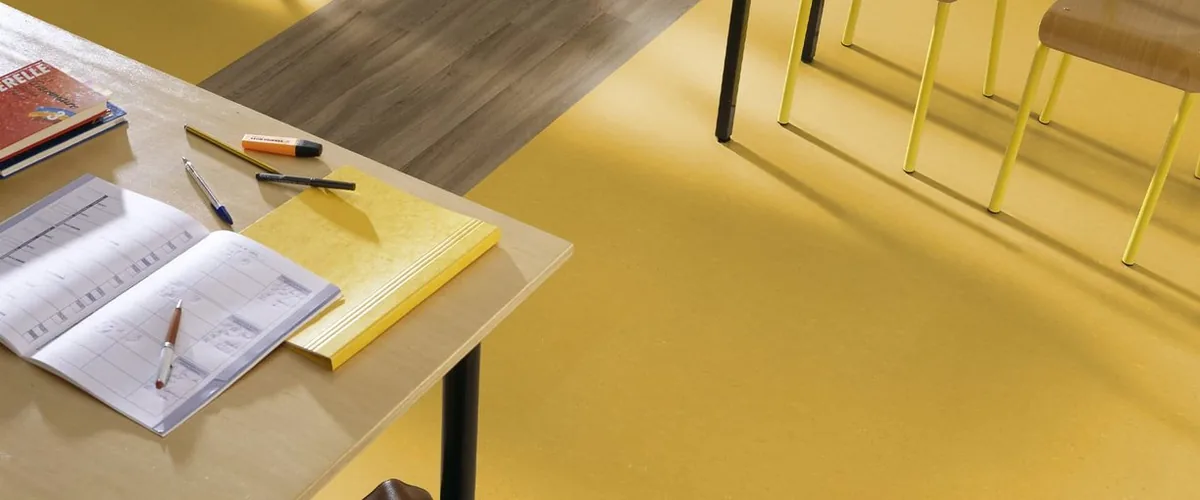
Linoleum is a resilient floor made from linseed oil, wood flour, limestone and resins on a jute backing: a natural material, not vinyl. It makes sense in dry areas with medium to high traffic—classrooms, offices, libraries, clinics—where durability and low environmental impact matter. It doesn't suit areas that get wet often or a damp subfloor: there a vinyl floor performs better.
What linoleum is and what it's made of
Linoleum has existed since the 19th century and its basic recipe hasn't changed: oxidized linseed oil acting as a binder, mixed with wood flour, ground limestone, resins and pigments, pressed onto a jute mesh. The color runs through the full thickness of the wear layer, so wear doesn't reveal a different color underneath.
The group's flooring line includes Gerflor's DLW Linoleum. According to the manufacturer, it's made of 98% organic and mineral raw materials (linseed oil, wood, limestone, jute and resin); 76% of its materials are rapidly renewable, 40% of its content is recycled and the product is 100% recyclable.
- Organic and mineral: 98 %
- Rapidly renewable: 76 %
- Recycled content: 40 %
- Recyclable: 100 %
- Source: Gerflor datasheet (DLW Linoleum)
Linoleum isn't vinyl: the difference that matters
People call almost any roll flooring «linoleum», but it's not the same. Vinyl is PVC, a synthetic plastic; linoleum is a naturally sourced material. In practice, the difference is in how they behave:
- Water: vinyl handles moisture and frequent mopping better; linoleum needs dry areas and little water when cleaning.
- Cleaning: linoleum doesn't tolerate strong alkaline cleaners; use pH-neutral products.
- Environment: linoleum is the choice when the project prioritizes renewable materials.
- Color: both offer many designs; in linoleum the color is solid through the wear layer.
| Criterion | DLW Linoleum | Mipolam Robust EL7 | LVT Creation 55 |
|---|---|---|---|
| Base | Linseed, wood, jute | Homogeneous PVC | Layered PVC |
| Format | Roll | Roll | Tiles and planks |
| Strength | Renewable materials | Heavy traffic, ESD | Wood or stone look |
| Use class | Ask the advisor | 34-43 | 33-42 |
| Moisture | Dry areas only | Handles it better | Handles it better; R10 |
Where linoleum makes sense
Linoleum performs in dry interiors with constant foot traffic, where you want a continuous floor that's warm underfoot with low environmental impact. Typical uses:
- Schools and universities: classrooms, corridors and libraries.
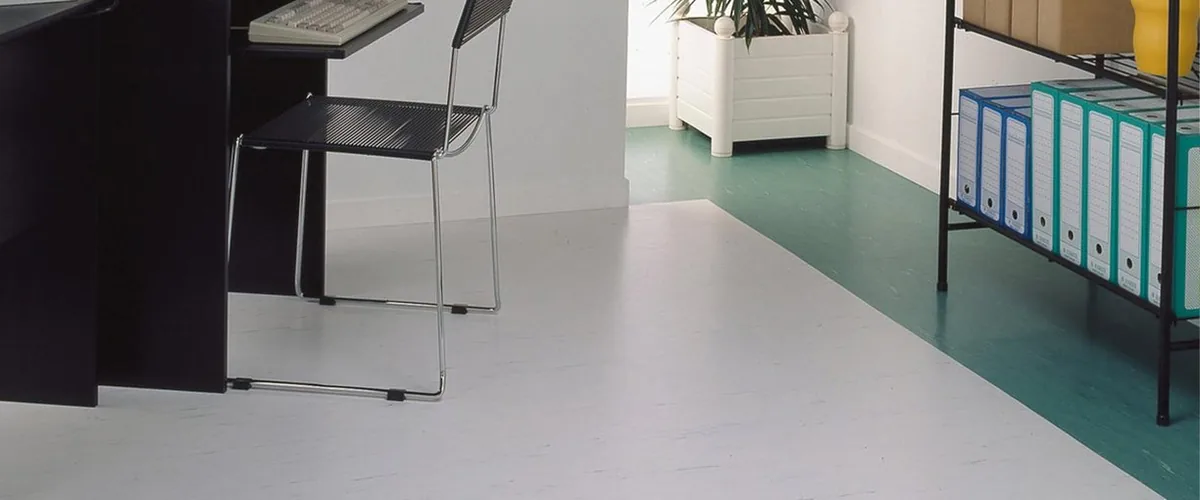
- Offices and administrative areas.
- Doctor's offices and dry areas of clinics.
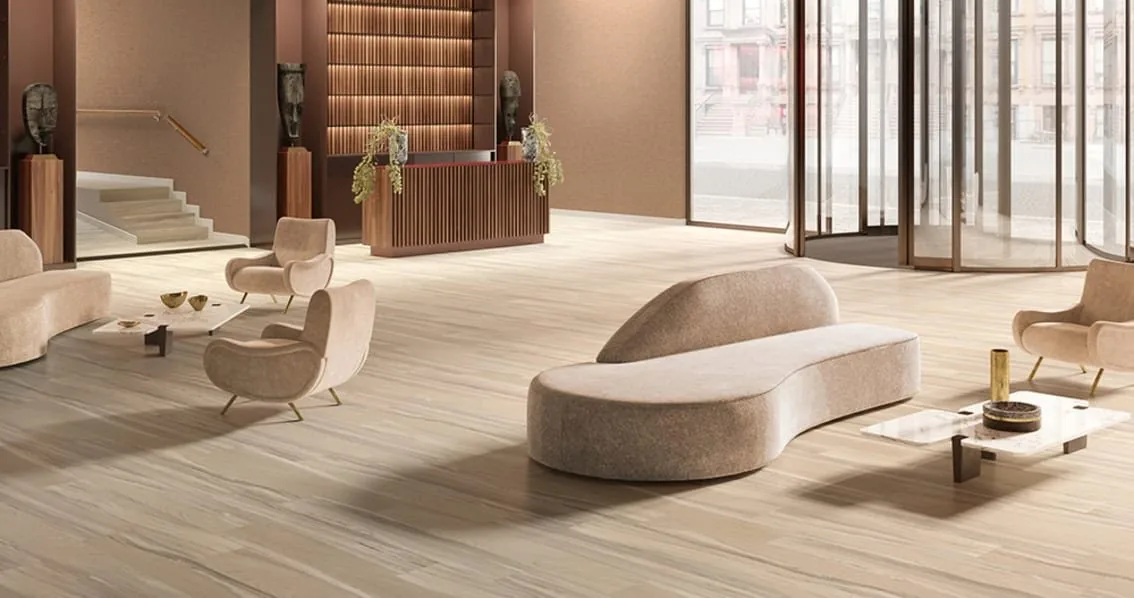
- Retail and cultural spaces with medium to high traffic.
- Projects seeking green-building credits for renewable or recycled materials (confirm with your consultant).
Where it doesn't fit and what to use instead
Linoleum's weak point is water. In bathrooms, showers, kitchens that get hosed down, outdoors or over a subfloor with rising damp, it warps, lifts or stains. Vinyl is the better fit there.
If the area has very heavy traffic or needs static control—equipment rooms, labs or hospital areas that require it—there's Gerflor's Mipolam Robust EL7, a compact homogeneous electrostatic-dissipative vinyl, with European use class 34-43, controlled electrical resistance of 10⁶ to 10⁸ ohm, Bfl-s1 fire rating and TVOC emissions under 10 µg/m³. For healthcare with heavy traffic, Mipolam Affinity needs no wax for life and, according to Gerflor, has antibacterial activity above 99%.
If you want a wood or stone look, LVT is the answer: Creation 55 has a 0.55 mm wear layer with a matte PUR+ finish, use class 33-42 and R10 slip resistance; Creation 30 has a 0.30 mm wear layer and class 23-31, for lighter use.
What the use class means
Resilient floors are rated with a two-digit number under the European standard EN ISO 10874. The first digit gives the type of use: 2 is domestic, 3 is commercial and 4 is light industrial. The second gives intensity, from moderate to very heavy. A 34-43 floor handles very heavy commercial and light industrial use; a 23-31 floor, heavy domestic and moderate commercial use.
Choose the class for the most demanding area of the project, not the average: an entrance corridor wears much faster than a private office.
Installation: the subfloor decides
Linoleum is glued to the subfloor and, in commercial use, roll seams are welded with a cord so the floor is continuous. Most problems don't come from the material but from the base: moisture, unevenness or dust. That's why installation belongs to a professional installer, who measures concrete moisture before starting and applies leveling compound if needed. Let the material acclimatize on site and respect the adhesive's curing time before allowing traffic or furniture.
It's normal for newly installed linoleum to show a yellowish cast: it forms as the linseed oil cures and fades with exposure to light.
- Linoleum: Linseed, wood, limestone, resins
- Jute backing: Natural mesh
- Adhesive: As the manufacturer specifies
- Leveling compound: If the subfloor isn't flat
- Concrete subfloor: Dry, clean and sound
Cleaning and maintenance
The rule is little water and neutral pH. Sweep or vacuum daily to remove grit, which is what scratches; mop with a damp, not soaked, mop and a neutral cleaner. Avoid strong alkaline cleaners, solvents and excess water on the seams. Put mats at entrances and felt pads on furniture legs. Follow the maintenance plan the manufacturer specifies for your model.
Where to get a quote for linoleum and resilient floors
DLW Linoleum, Mipolam vinyls and Gerflor's Creation LVT are part of the architectural flooring line the group offers in El Salvador, Guatemala, Nicaragua and Panama, within the Hunter Douglas catalog, of which it is an authorized distributor. To get a quote, send the area in square meters, the use of each space and the condition of the subfloor; an architecture advisor will contact you during business hours.
- El Salvador: Zaragoza, Antiguo Cuscatlán and San Miguel.
- Guatemala (CMARKET): Mixco, Río Hondo and Xela.
- Nicaragua: Managua. Panama: Panama City.
Summary: what to choose
| If… | Then… |
|---|---|
| Dry area with foot traffic | Linoleum |
| The project prioritizes renewable materials | DLW Linoleum (98% organic and mineral, per Gerflor) |
| Bathrooms, kitchens or wet areas | Vinyl, not linoleum |
| You need static control | Electrostatic-dissipative Mipolam Robust EL7 |
| You want a wood or stone look | Creation 55 LVT |
| The subfloor is damp | Fix it before installing any floor |
Get a quote without leaving
Want to work it out with an advisor?
Topic: Linoleum flooring
Which country is your project in?
Common mistakes
Calling vinyl linoleum
They're different materials with different care; ask for the datasheet and confirm what you're buying.
Installing over damp concrete
Subfloor moisture lifts and stains the floor; measure it first.
Putting it in bathrooms or kitchens
Frequent water warps it; vinyl belongs there.
Cleaning with harsh products
Alkaline cleaners and excess water damage it; use neutral pH.
Thinking the yellow cast is a defect
It comes from the linseed curing and fades with light.
Frequently asked questions
Is linoleum the same as vinyl?
No. Vinyl is PVC, a synthetic plastic. Linoleum is made from linseed oil, wood flour, limestone and resins on jute. They install similarly, but vinyl handles moisture better.
Can linoleum get wet?
It handles damp mopping and the occasional spill wiped up quickly, but not frequent water or pooling. For bathrooms, showers or kitchens that get washed down, use vinyl.
How long does a linoleum floor last?
It depends on traffic, installation and maintenance. Properly installed on a dry subfloor and cleaned with neutral pH, it's a long-lasting floor; ask the advisor for the manufacturer's warranty on the model you quote.
How much does linoleum flooring cost per square meter?
It depends on the model, the area, subfloor preparation and installation. Send the square meters, the use of the space and the subfloor condition to get a quote.
Where to buy linoleum flooring in Guatemala or Panama?
The group's architectural flooring line, including Gerflor's DLW Linoleum, can be quoted in El Salvador, Guatemala (CMARKET), Nicaragua and Panama. Request the quote from this page with the area and use.
Which is better for a school, linoleum or vinyl?
For dry classrooms, corridors and libraries, linoleum works very well. For bathrooms, kitchens and labs with water, vinyl. Many projects combine both by area.
Ready for the next step?
Get a quote for architectural flooring