
Short answer
To size a frame scaffold, divide the length of the wall by the platform length to get the number of bays, and the height of the top platform by your system's frame height to get the number of levels. Always round up. With bays and levels you count the pieces: frames, cross braces, platforms and base jacks or casters at the bottom, plus guardrails and toe boards.
Scaffold types and when to use each
The frame (tubular) scaffold is the most common on Central American jobsites: prefabricated frames joined by cross braces, quick to assemble and easy to haul. It's used for facades, plastering, painting and ceilings. The system (multidirectional) scaffold uses posts with nodes where pieces connect in several directions; it adapts to irregular shapes and higher loads, but takes more planning. The mobile scaffold is a frame scaffold on braked casters, for indoor work on firm floors. The suspended scaffold hangs from the structure on cables and is used on tall facades where building up from the ground doesn't pay.
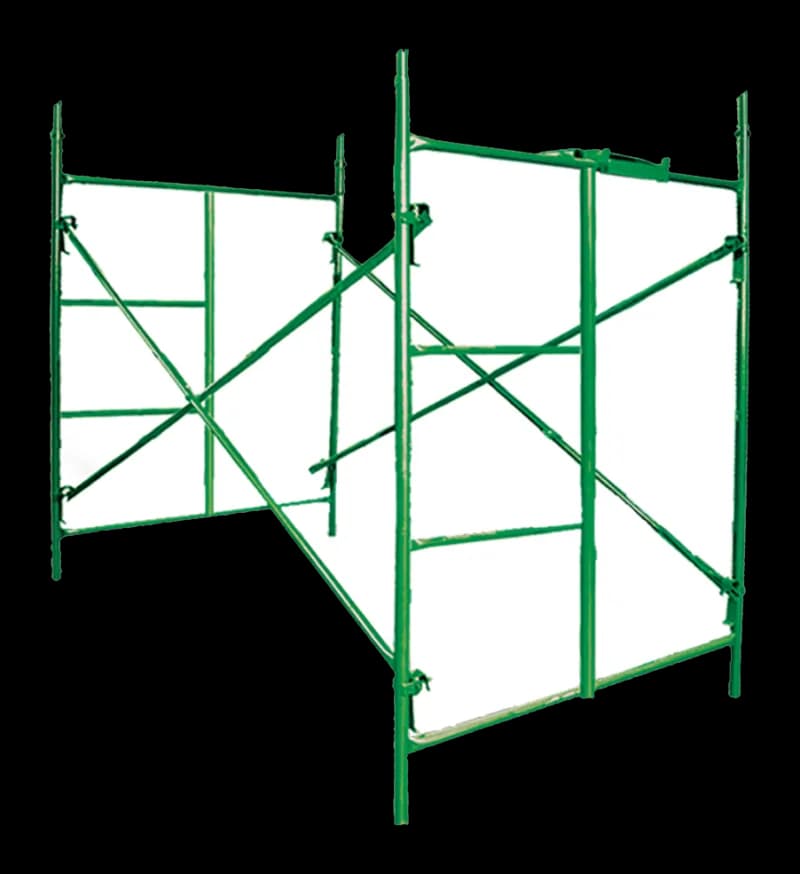
The parts of a frame scaffold
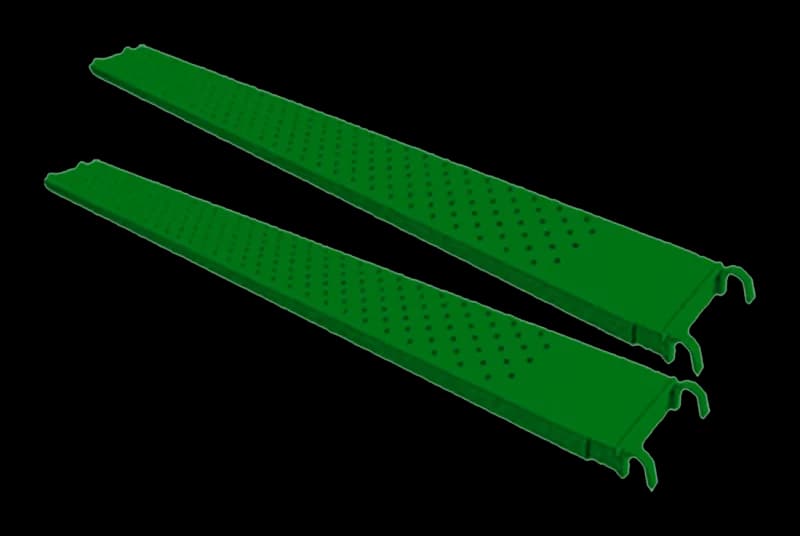
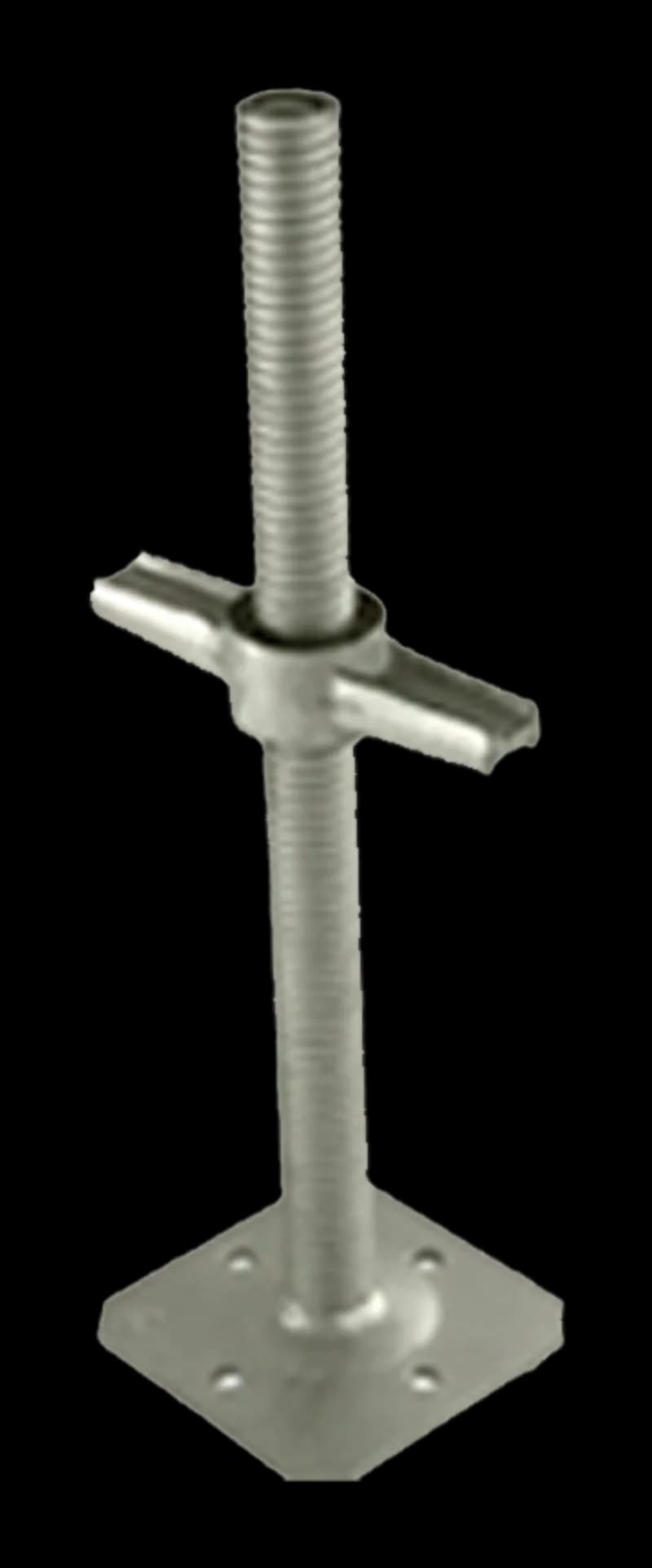
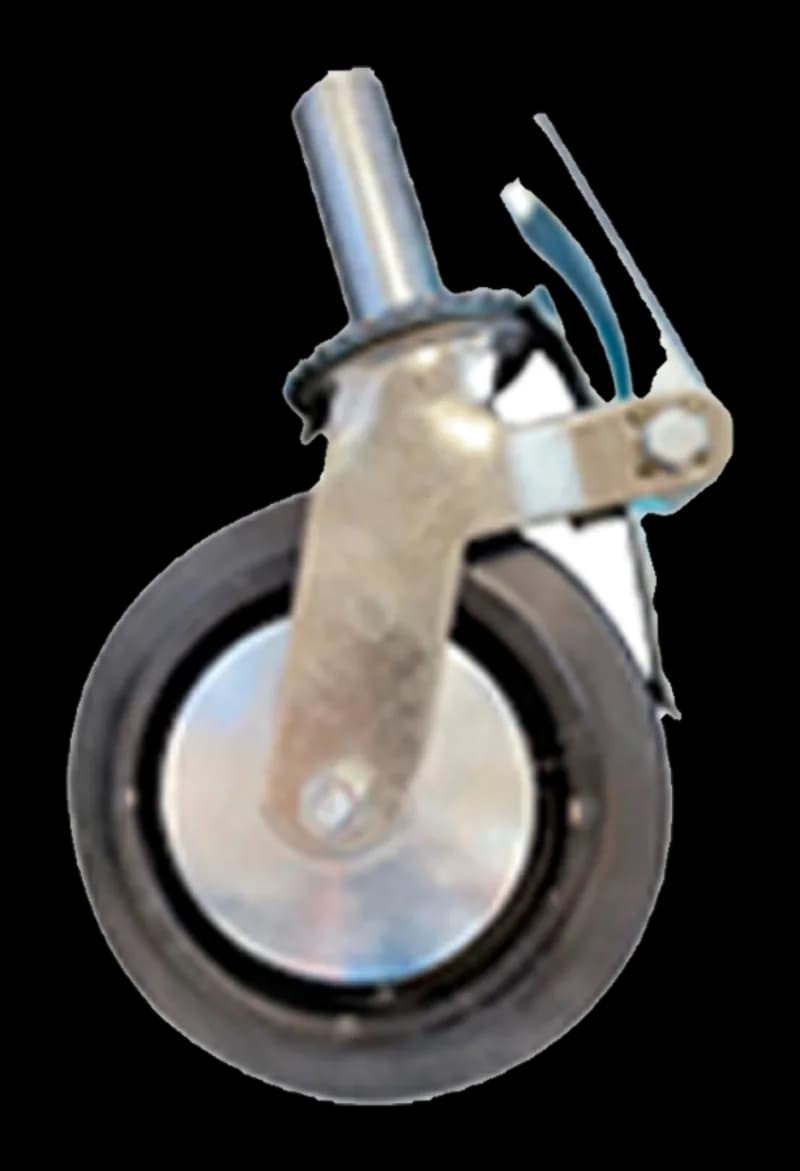
In the SIMAQ scaffolding line each piece has a code: the frame or «cuerpo» (A001), the cross brace that joins two frames and keeps them square (A002), the adjustable base jack that levels the scaffold on uneven ground (A003), the anti-slip metal platform, 25 cm wide by 3.00 m long (A004), and the caster, a swivel wheel with a brake to move the assembled scaffold (A005).
In the region a «cuerpo» is the one-level module: two frames joined by their cross braces. When you build several in a row, the inner frames are shared; that's why it's better to count by pieces, not just by modules.
- Guardrail and toe board: Along every open edge
- A004 platforms: 25 cm × 3.00 m, no gaps
- A001 frames + A002 braces: One level per frame
- A003 jacks or A005 casters: Level or move it
- Firm base: Floor or sole board
Step 1: length sets the bays
A bay is the span between two frames, and the platform sets its length. With 3.00 m platforms: bays = wall length ÷ 3.00 m, rounded up. A 12 m wall needs 4 bays; a 13 m wall needs 5, because no span can be left without a platform.
On each level you need one more frame than bays (4 bays → 5 frames) and two cross braces per bay, one on each face. Platforms per bay depend on your frame's usable width: divide that width by 25 cm and cover it fully, with no gaps.
Step 2: height sets the levels
Decide how high the top platform must be, not the ceiling height: you normally stand on it, with the work point at chest height or a bit above. Then: levels = top platform height ÷ your system's frame height, rounded up.
Frame height varies between manufacturers and models; take it from the datasheet or measure the piece before calculating. The base jacks add a few centimeters, but don't use them to gain height: their job is leveling.
- Measure length and height: Wall and top platform
- Bays = length ÷ 3.00 m: Round up
- Levels = height ÷ frame height: Round up
- Pieces per level: Frames = bays + 1
- Base and protection: Jacks, guardrails, toe boards
Example: a 12 m wall
To plaster a 12 m wall: 12 ÷ 3.00 = 4 bays. For each level you need 5 frames, 8 cross braces and enough platforms to cover the width of 4 bays. At the base, each frame stands on two legs: 10 base jacks for leveling. Multiply frames, braces and platforms by the number of levels from step 2, and add guardrails and toe boards on the working level and every open edge.
To compare renting against buying that many pieces, the site's rent vs. buy calculator helps you find the break-even point.
- Bays: 4 (12 m ÷ 3.00 m).
- Frames per level: 5 (bays + 1).
- Cross braces per level: 8 (2 per bay).
- Base jacks: 10 (2 per frame), or casters if it will move.
Safety: base, guardrails and tie-ins
Most scaffold accidents come from a poorly supported base or an unprotected edge. These rules are general; your country's safety regulations and the system manual take precedence.
- Level base with jacks on firm ground or a sole board, never on loose blocks.
- Fully decked platform, no gaps, with guardrail and toe board on open edges.
- Tie the scaffold to the structure per the regulations as it gains height.
- Climb the system's ladder, not the cross braces.
- On a mobile scaffold: brakes on while working and never move it with people on it.
- Inspect it before each shift: pins, braces and platforms in place.
Mobile scaffold or aerial work platform
If you work indoors and need to move along a wall or ceiling, put the scaffold on casters: the SIMAQ A005 caster has a braked swivel wheel and an insertion stem. The height it can reach without tie-ins is limited by the regulations and the manufacturer according to the base width.
If the task is short and only one or two people go up with tools, an aerial work platform can be faster than building a scaffold: the catalog has SIMAQ (SQ 140X PRO) and Hangcha (HS series) scissor lifts in all four countries.
Renting or buying scaffolding, and where
Rent if the scaffold is for a one-off job or you need many pieces for a few weeks: RentaCentro, a group company, rents scaffolding. Buy if your crew uses it all year, because the pieces are modular and get reused from job to job.
The SIMAQ scaffolding line—the group's own light-equipment brand—is available in El Salvador, Guatemala, Nicaragua and Panama: frames, cross braces, base jacks, platforms, casters and shoring props. Request your quote with the length, height and use, and an advisor will contact you during business hours.
- El Salvador: Zaragoza (headquarters with warehouse and showroom), Antiguo Cuscatlán and San Miguel.
- Guatemala (CMARKET): Mixco, Río Hondo and Xela.
- Nicaragua: Managua. Panama: Panama City.
Summary: what to choose
| If… | Then… |
|---|---|
| Facade, plastering or exterior painting | Frame scaffold |
| Indoor work that moves along a wall | Mobile scaffold on braked casters |
| Irregular shape or higher loads | System scaffold |
| Short task for one or two people | Scissor lift |
| You want to know how many bays | Wall length ÷ 3.00 m, rounded up |
| You use it on a single job | Rent through RentaCentro |
Get a quote without leaving
Want to work it out with an advisor?
Topic: Scaffolding
Which country is your project in?
Common mistakes
Counting only modules
In a run, frames are shared; count frames, braces and platforms separately.
Standing it on blocks or bricks
They crack under load; use base jacks on a sole board or firm floor.
Incomplete decking
A gap between planks is a fall point.
Using the base jack to gain height
Overextended it loses stability; add a level.
Moving the scaffold with people on it
A caster that catches tips it over; get everyone down first, then release the brakes.
Frequently asked questions
How many scaffold frames do I need?
Bays = length ÷ platform length (3.00 m for SIMAQ) and levels = top platform height ÷ frame height, rounded up. In pieces: bays + 1 frames and 2 cross braces per bay, on every level.
What size is a scaffold platform?
The SIMAQ A004 platform is 25 cm wide by 3.00 m long and anti-slip, according to its datasheet. Other systems use other sizes: confirm it before calculating.
Where can I buy scaffolding in Guatemala or Nicaragua?
The SIMAQ scaffolding line is available in all four countries: in Guatemala through CMARKET (Mixco, Río Hondo and Xela) and in Nicaragua in Managua.
Is it better to rent or buy scaffolding?
Rent for a one-off job; buy if you use it all year. RentaCentro, a group company, rents scaffolding.
How much does scaffolding cost?
It depends on how many pieces you need, whether it has casters and the payment method. Work out bays and levels and request a quote with those quantities; light equipment can be paid in installments with a participating credit card.
Ready for the next step?
See SIMAQ scaffolding