Short answer
Choose the compactor by the soil first and by the space second. If the soil is cohesive (clay, silt), you need impact or kneading: a rammer (jumping jack) or a padfoot roller. If it's granular (sand, gravel, base), you need vibration: a vibratory plate or a smooth-drum roller. Then the space sets the size: narrow trench, yard or earthworks.
The rule: soil first, space second
In cohesive soil the particles are fine and stick together; water holds them and vibration barely rearranges them. To push the air out you have to hit or knead them: that's what a rammer's shoe and a padfoot roller's feet do.
In granular soil the grains are loose. Vibration makes them bounce and settle, and the voids close. That's where a vibratory plate or a smooth-drum roller performs. Using a plate on clay leaves a smooth surface over a loose layer; using a rammer on loose sand just pushes it around.
With the type settled, the space sets the size: utility trench, sidewalk, parking lot or earthworks.
What soil and space do you have?
- Clay in a trench or small area → Rammer (jumping jack)
- Clay over a large area → Padfoot roller
- Sand, gravel or pavers → Vibratory plate
- Granular base on roads or earthworks → Smooth-drum vibratory roller
How to tell your soil type: the fist test
Grab a handful of moist material from the site and squeeze it. If it forms a ball that keeps your finger marks and can be molded like modeling clay, it's cohesive. If it crumbles when you open your hand, or the grains feel gritty and you can see them, it's granular. Many fills are mixed: decide by what dominates.
The same ball gives you a hint about moisture: if you drop it and it breaks into a few pieces, you're close to the right point; if it turns to dust, it needs water; if it flattens or leaves water on your hand, it's too wet. It's a field test and doesn't replace the lab test the specification calls for.
Rammer (jumping jack): clay and narrow trenches
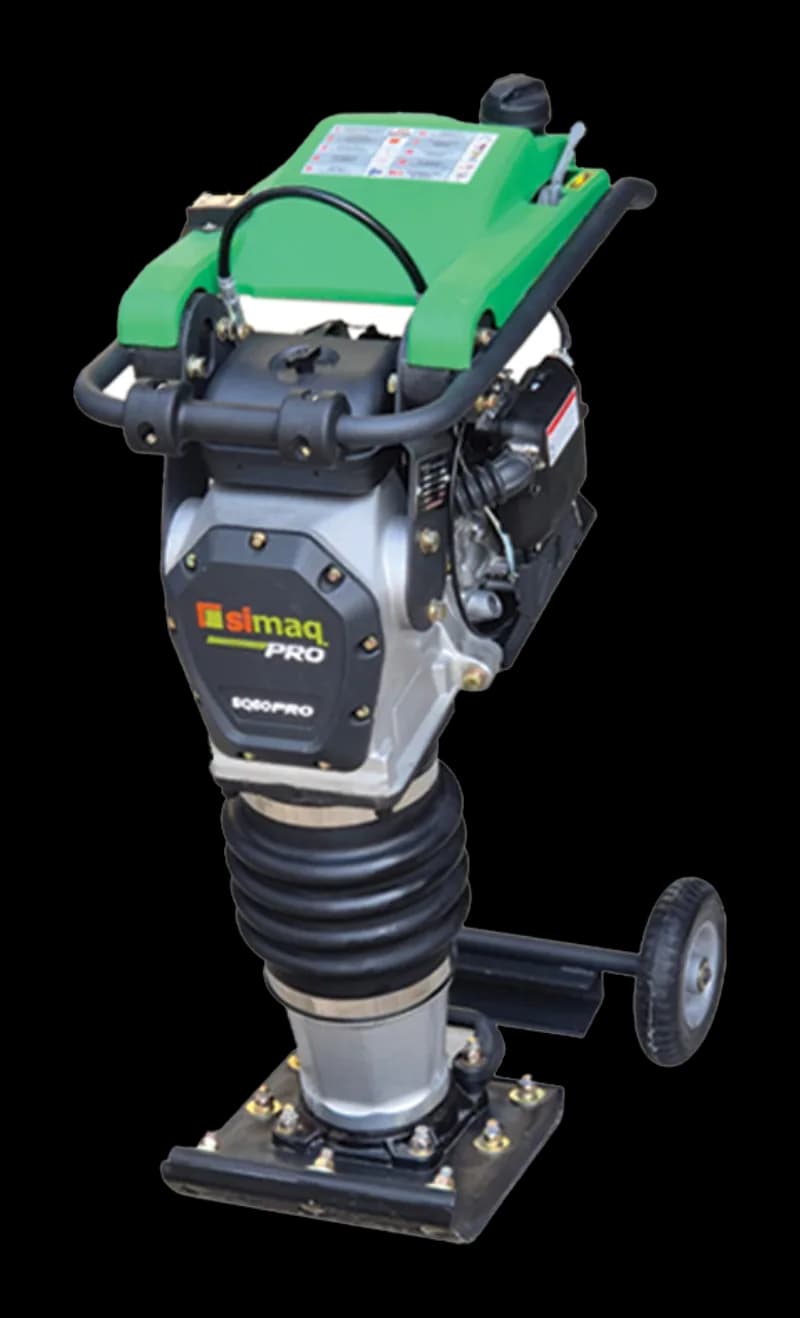
The rammer—«bailarina» or «canguro» on Latin American sites—hits the ground with a narrow shoe. It's the walk-behind compactor for pipe-trench backfill, footing bases and cohesive soil in spaces no other machine can reach.
Two catalog examples: the SIMAQ SQ60 PRO 2 delivers 13.7 kN of impact with a 34 × 29 cm shoe at 69 kg, according to its datasheet. The Wacker Neuson BS60-2plus gives 18 kN with 80 mm of shoe stroke at 66 kg, according to Wacker Neuson; more stroke means more energy per blow. If you work indoors, in basements or in poorly ventilated trenches, Wacker Neuson offers battery rammers (AS50e and AS60e) that produce no exhaust fumes.
Vibratory plate: sand, gravel, base and pavers
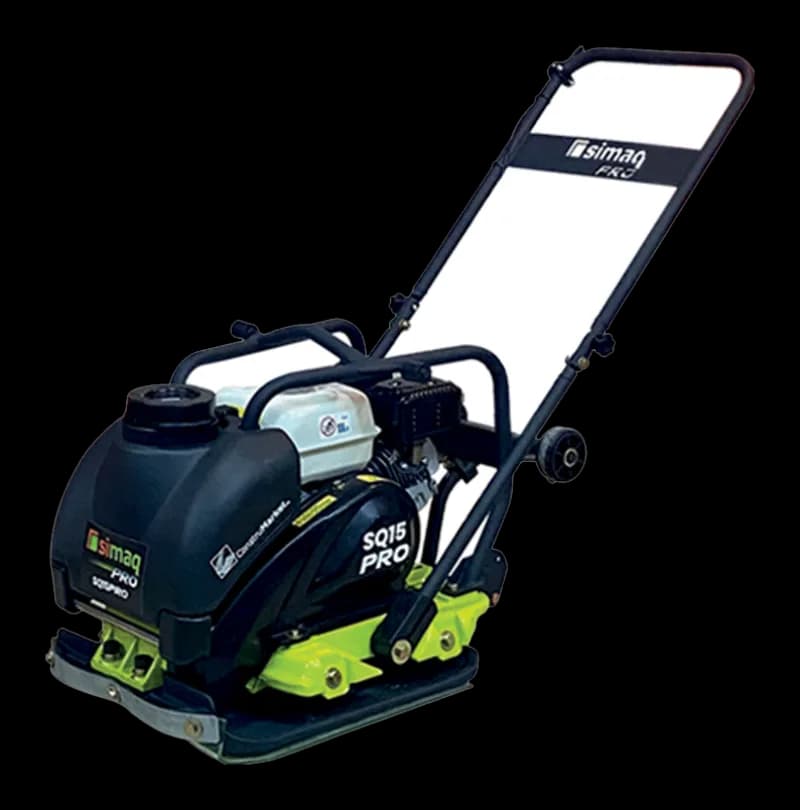
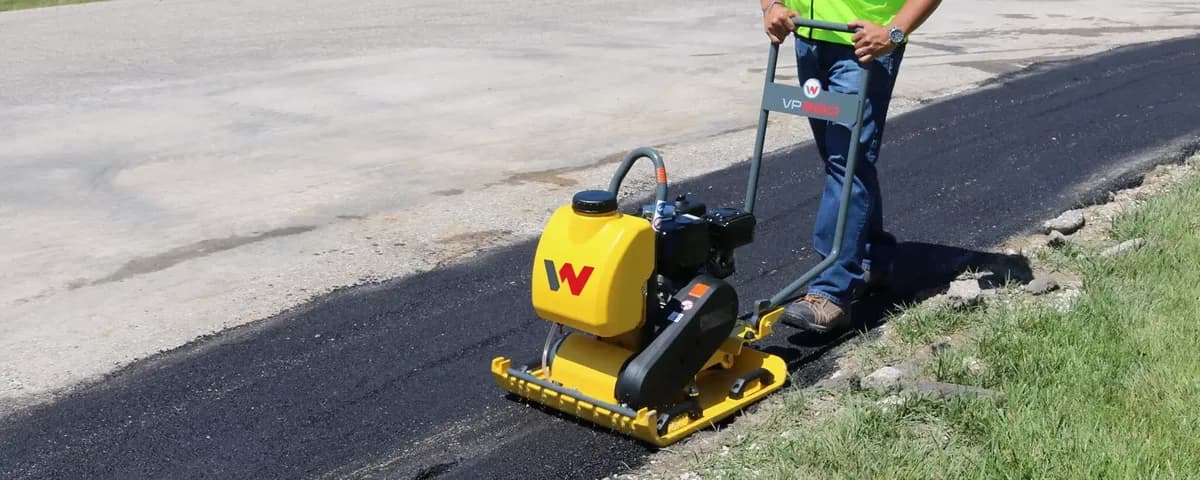
The plate vibrates on a wide base and moves forward by itself. It's the tool for granular sub-base and base, sand under pavers and sidewalk repairs. The SIMAQ SQ15 PRO is a forward plate with a steel base for base courses and pavers.
If the layer is thicker or the work is daily, look at a reversible plate: it goes forward and backward, so it works in wide trenches without turning around. The diesel Wacker Neuson DPU 2550H delivers 25 kN over a 500 mm width and covers 540 m²/h, according to Wacker Neuson. For indoor work there are also battery plates (APS series), with no exhaust fumes.
Compact rollers: when walking behind isn't enough
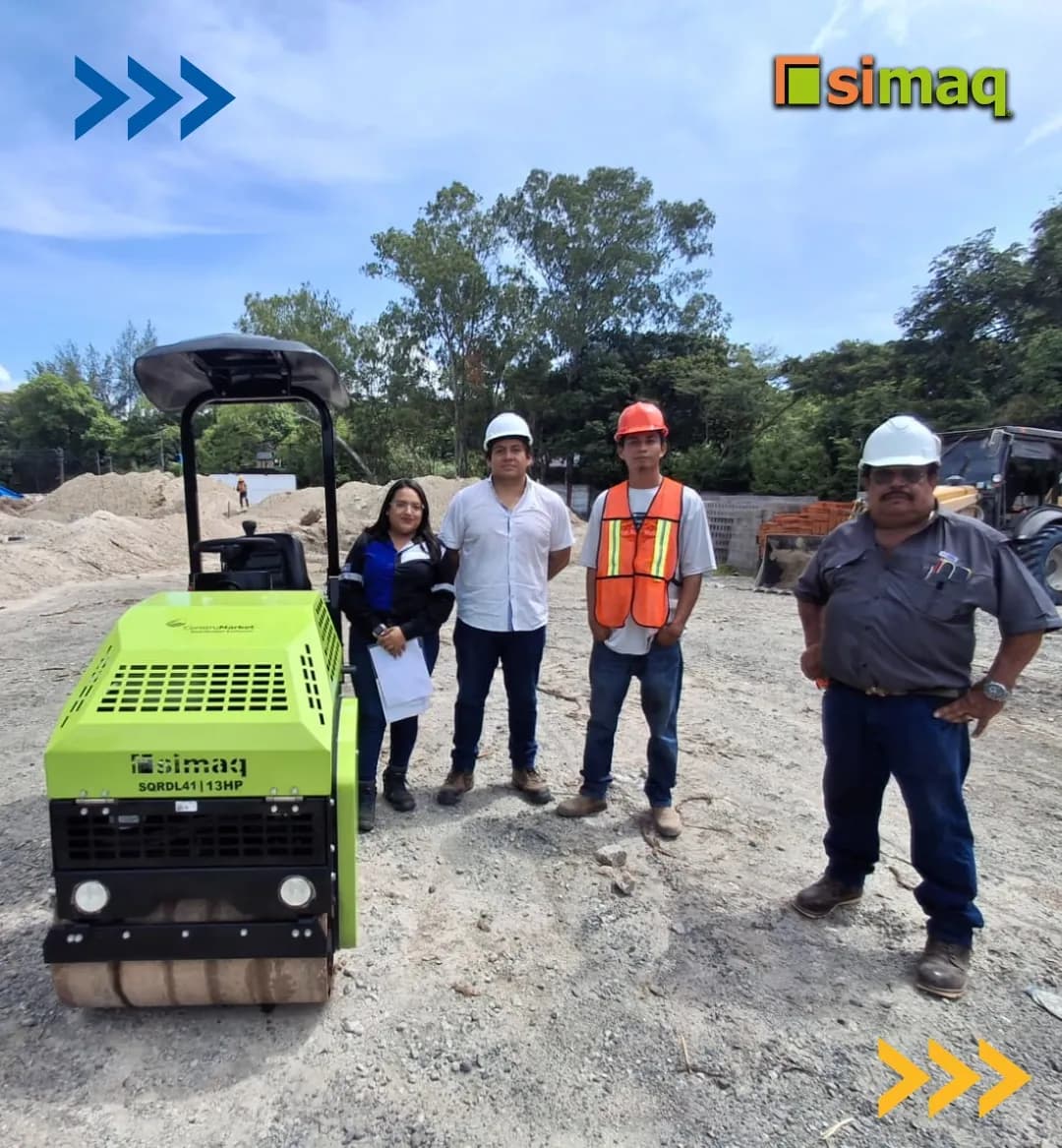
When the area grows—long sidewalk, parking lot, street—the roller covers more per pass. The SIMAQ line goes from walk-behind to ride-on: the SQRDWB L34 is a 680 mm double-drum roller you walk behind; the SQRD L41 and L51 carry a seated operator, and the L51 adds a 900 mm drum and 22 kN, according to SIMAQ. The L61 and L71 step up to 3 and 4.2 t for streets and mid-size earthworks.
For trench backfill in clay there's the SIMAQ SQRPTRC L202: a 1.53 t padfoot roller driven by remote control, so nobody steps into the trench while it compacts.
Large rollers: smooth drum or padfoot
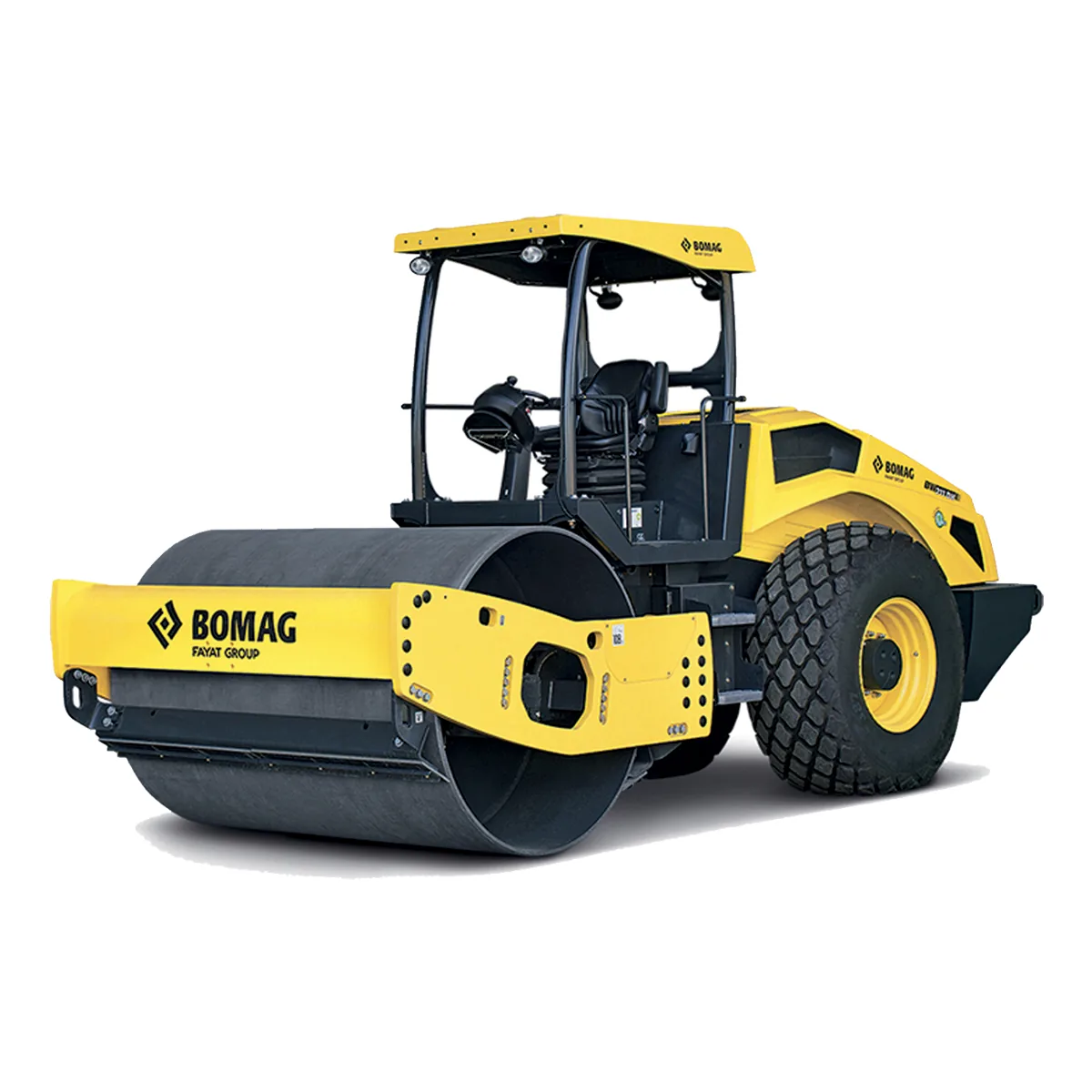
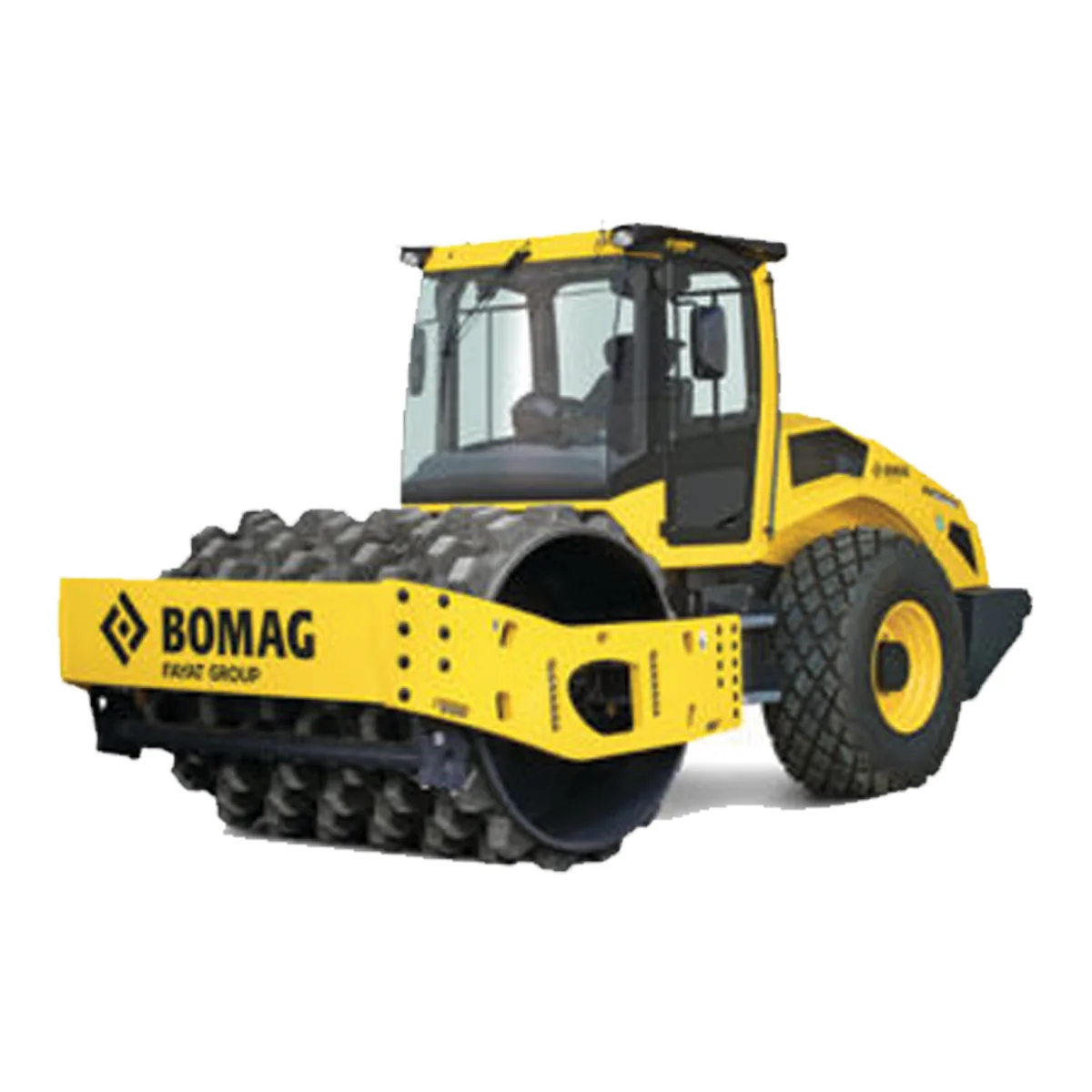
On earthworks, roads and land subdivisions the rule is the same, at scale. BOMAG offers the same chassis with two drums: the smooth BW 211 D-5, 10.6 t and 2,130 mm wide, for gravel, sand and sub-base; and the BW 212 PD-5 padfoot, with 150 feet and 12.94 t, for clay and silt, according to BOMAG's datasheets. Picking the wrong drum isn't fixed with more passes.
| Criterion | BW 211 D-5 | BW 212 PD-5 |
|---|---|---|
| Drum | Smooth | Padfoot, 150 feet |
| Operating weight | 10.6 t | 12.94 t |
| Drum width | 2,130 mm | 2,130 mm |
| Soil | Gravel, sand, base | Clay and silt |
| How it compacts | Vibration | Kneading and vibration |
Moisture, layers and passes
Not even the right machine compacts dry or waterlogged soil. Every soil has an optimum moisture at which it reaches maximum density; the laboratory Proctor test defines it, and the project specification tells you what percentage of that density you must achieve.
Compact in thin layers: a walk-behind machine's energy doesn't reach the bottom of a thick layer, and whatever stays loose underneath settles later. The equipment maker and the specification set the maximum thickness. To estimate volume, passes and output, use the site's compaction and passes-and-density calculators.
- Identify the soil: Fist test
- Adjust moisture: Near Proctor optimum
- Spread thin layers: Per equipment and spec
- Compact with the right machine: Impact or vibration
- Check density: Before the next layer
Where to buy or rent a compactor in Central America
Grupo ConstruMarket carries SIMAQ compactors—the group's own light-equipment brand—in El Salvador, Guatemala, Nicaragua and Panama: rammer, plate and rollers. Wacker Neuson (rammers, plates and rollers, including battery models) and BOMAG (soil rollers) are available in El Salvador and Guatemala. Price depends on model, configuration and payment method: request your quote with the soil type and area, and an advisor will contact you during business hours.
If you need one for a single project, RentaCentro—a group company—rents the SIMAQ SQ60 PRO compactor.
- El Salvador: Zaragoza (headquarters with workshop), Antiguo Cuscatlán and San Miguel.
- Guatemala (CMARKET): Mixco, Río Hondo and Xela.
- Nicaragua: Managua. Panama: Panama City.
Summary: what to choose
| If… | Then… |
|---|---|
| You're backfilling a trench with clay | Rammer or remote-control padfoot roller |
| You're compacting sand or base under pavers | Vibratory plate |
| The granular layer is thick or use is daily | Reversible plate |
| You work indoors or without ventilation | Battery rammer or plate |
| Street, parking lot or mid-size earthworks | Ride-on roller |
| Large earthworks in clay | Padfoot roller, such as the BOMAG BW 212 PD-5 |
Get a quote without leaving
Want to work it out with an advisor?
Topic: Compactor
Which country is your project in?
Common mistakes
A plate on clay
It leaves a smooth surface over a loose layer; the floor sinks later.
Layers too thick
The energy doesn't reach the bottom; no number of passes fixes it.
Ignoring moisture
Dry soil won't densify and saturated soil bounces under the machine.
A gasoline engine in an enclosed space
Exhaust builds up; use battery equipment or ensure ventilation.
Stepping into a deep trench to compact
With a remote-control roller the operator stays outside.
Frequently asked questions
What is a walk-behind (manual) compactor?
It's one the operator guides on foot: the rammer or jumping jack, which hits, and the vibratory plate, which vibrates. The first is for clay and trenches; the second, for sand, gravel and pavers.
Rammer or vibratory plate?
Rammer if the soil is cohesive or the space is narrow; plate if the material is granular and the area is open. Do the fist test before deciding.
Which compactor do I use for trench backfill?
In a narrow trench, a rammer such as the SIMAQ SQ60 PRO 2 or the Wacker Neuson BS60-2plus. In a wider trench with cohesive soil, a remote-control padfoot roller such as the SIMAQ SQRPTRC L202.
How much does a compactor cost in El Salvador or Guatemala?
It depends on the type (rammer, plate or roller), brand, engine (gasoline, diesel or battery) and payment method. Request a quote with your soil and area; light equipment can be paid in installments with a participating credit card.
Can I rent a compactor?
Yes. RentaCentro, a group company, rents the SIMAQ SQ60 PRO compactor. If you use it only a few weeks a year, renting usually makes more sense than buying.
Ready for the next step?
Calculate your compaction