Short answer
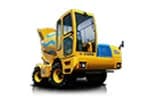
A self-loading mixer is an all-terrain machine with a mixing drum, a loading bucket and its own water tank: it loads the sand and gravel, takes in the cement and water, mixes while it travels and discharges the concrete through its chute where it's needed. It pays off when the job needs more concrete than a drum mixer and a crew can turn out, but the ready-mix truck can't get there, can't get in or is far from the plant. At D'Avino, output per cycle runs from 1.1 m³ on the 415 to 5.1 m³ on the 660, per their official datasheets.
What a self-loading mixer is
It's a small concrete plant on wheels. It's also called a self-loading concrete mixer or self-loading mixer. One machine brings together three things that on another site would take three pieces of equipment: the bucket that loads the aggregates, the drum that mixes and the vehicle that carries the concrete to the work front.
D'Avino units have hydrostatic drive, per their datasheets, and climb grades of 40% to 50% depending on the model. On the rotating models the cab, bucket and discharge turn with the operator: 180° discharge on the 440 and 560, 270° on the Revolution R30, 315° on the R40 and the full 360° turn on the DELTA.
How it works, step by step
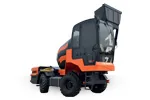
The cycle is the same on every model; what changes is the size and how far the machine turns. The operator runs loading, water and the drum from the cab; the DELTA also has ground controls for the water meter and pump, drum rotation and the chute, per its datasheet.
- Loads the aggregates: With its bucket: from 230 L on the 415 to 600 L on the 440, 560 and 660
- Adds cement and water: Water comes from its own tank
- Mixes: In the drum, also while traveling
- Travels: Across the site, to the pour
- Discharges: Through the chute, where it's needed
How much concrete each D'Avino yields
D'Avino's datasheet gives output per cycle as “Output Class S1”: the cubic metres of concrete each cycle produces, with S1-consistency concrete, which is a dry mix. That's what you'll pour; drum volume is something else and is always larger (on the 415, a 1,400 L drum for 1.1 m³ of concrete).
To choose, count the cubic metres you need per day and how many cycles fit in your shift, with your site's loading, mixing, travel and discharge times. The DELTA, with its 600 L bucket, states a loading productivity of 18 m³ per hour on its datasheet.
- 415: 1.1 m³
- 440: 2.6 m³
- Revolution R30: 3 m³
- 560: 4.5 m³
- Revolution R40: 4.5 m³
- DELTA: 4.5 m³
- 660: 5.1 m³
- Source: D'Avino official datasheets (davinomixer.com).
Self-loading mixer, drum mixer or ready-mix
They're three ways to get concrete on site, and each wins on its own ground.
The drum mixer (cement mixer) mixes in small batches and a crew loads it by hand: at SIMAQ, the 1.5-bag mixer has a 365 L drum and yields about 0.2 m³ per batch in a 1:2:3 mix. It's the one for houses, columns and small slabs; which one to choose is covered in the “How do you choose a concrete mixer?” guide on simaq.pro.
Ready-mix concrete comes from a plant in a truck mixer: large volumes, with the plant's batching, but it depends on the plant being close, the truck getting into your site and the dispatch schedule.
The self-loading mixer sits in between: it produces on site, with no plant and no loading crew, 1.1 to 5.1 m³ per cycle depending on the D'Avino model.
| Criterion | Drum mixer | Self-loading mixer | Ready-mix |
|---|---|---|---|
| Where it's made | On site | On site | At the plant |
| Who loads it | A crew by hand | The machine, with its bucket | The plant |
| Volume per batch | ≈0.2 m³ (1.5 bags, SIMAQ) | 1.1–5.1 m³ (D'Avino) | What the truck carries |
| Depends on | People and hauling | Aggregates on site and an operator | Distance to the plant and access |
When a self-loading mixer pays off
It pays off when several of these come together: the ready-mix plant is far or doesn't deliver to your area; the truck can't get in or can't make it down the road; the pour is spread over scattered fronts, as on roads, canals, rural jobs or parks; and daily volume is more than a drum mixer and a crew can turn out.
It doesn't pay off if you pour little and now and then (the drum mixer is enough) or if you have a plant nearby, good access and large one-time pours (ready-mix handles it). Nor does it replace quality control: the operator batches the mix, so you need a clear recipe and someone who sticks to it. The DELTA, for example, has an electronic water meter and optional weighing with pressure transducers or load cells, per its datasheet.
What's your pour like?
- Small and now and then → Drum mixer
- Large, with a plant nearby and good access → Ready-mix
- Daily, with no plant nearby or no truck access → Self-loading mixer
- Spread over scattered fronts → Self-loading mixer
Which D'Avino size to choose
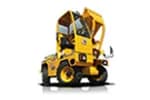
The 415 is the smallest: 1.1 m³ per cycle, a 230 L bucket, front loading and discharge and 2,600 kg empty, for small jobs and narrow access. The 440 (2.6 m³) and the Revolution R30 (3.0 m³) are the middle step; the R30 adds a seat and discharge that swivel 270° so you don't manoeuvre the chassis. The 560, the Revolution R40 and the DELTA give 4.5 m³ per cycle, and the 660 reaches 5.1 m³, the largest in the line, per their datasheets.
Bigger isn't always better: it weighs more (the 415 weighs 2,600 kg empty and the R40, 8,400 kg), needs more room to manoeuvre and an aggregate stockpile that keeps it working. Grupo ConstruMarket sells D'Avino in El Salvador, Guatemala, Nicaragua and Panama; tell us your daily volume and your site and we'll recommend the model.
Summary: what to choose
| If… | Then… |
|---|---|
| You pour little and now and then | Site drum mixer |
| Large pour, plant nearby and good access | Ready-mix concrete |
| The truck can't reach you or the plant is far | Self-loading mixer |
| Small job and narrow access | D'Avino 415 (1.1 m³ per cycle) |
| Medium job with tight manoeuvring | Revolution R30 (3.0 m³, 270° swivel) |
| High daily volume | 560, R40, DELTA (4.5 m³) or 660 (5.1 m³) |
Get a quote without leaving
Want to work it out with an advisor?
Topic: D'Avino self-loading mixer
Which country is your project in?
Common mistakes
Choosing by drum volume
What you pour is the datasheet's output per cycle, not the drum's litres.
Buying big without an aggregate stockpile
A self-loading mixer waiting for sand yields less than a small one working.
Batching “by eye”
Strength comes from the recipe. Set cement, aggregates and water, and have the operator stick to it.
Putting it to work without a trained operator
It loads, drives and mixes at once: it's a machine, not a big drum mixer.
Take it to the job site
Print the checklist to go over it on site, or send the guide to your crew.
Frequently asked questions
What is a self-loading mixer?
An all-terrain machine with a loading bucket, mixing drum and water tank that loads the aggregates, mixes the concrete, travels and discharges it at the work front. It's a small concrete plant on wheels.
How many m³ of concrete does a self-loading mixer make?
It depends on the model. At D'Avino, output per cycle (S1 class) runs from 1.1 m³ on the 415 to 5.1 m³ on the 660, per their official datasheets.
What's the difference between a self-loading mixer and a drum mixer?
The drum mixer mixes small batches and a crew loads it by hand. The self-loading mixer loads itself with its bucket, mixes far more per cycle and carries the concrete to the work front.
When is it better than ready-mix?
When the plant is far or doesn't deliver to your area, when the truck mixer can't get into the site or when the pour is spread over scattered fronts.
How much does a self-loading mixer cost?
It depends on the model, equipment and country. We don't publish prices: request a quote with your daily volume and site and we'll price the model that suits you.
Where to buy a D'Avino self-loading mixer in Central America?
Grupo ConstruMarket sells D'Avino self-loading mixers in El Salvador, Guatemala, Nicaragua and Panama.
Ready for the next step?
Get a quote for a D'Avino self-loading mixerGrupo ConstruMarket · Job site checklist
What is a self-loading concrete mixer, and when is it better than a drum mixer or ready-mix?
A self-loading mixer is an all-terrain machine with a mixing drum, a loading bucket and its own water tank: it loads the sand and gravel, takes in the cement and water, mixes while it travels and discharges the concrete through its chute where it's needed. It pays off when the job needs more concrete than a drum mixer and a crew can turn out, but the ready-mix truck can't get there, can't get in or is far from the plant. At D'Avino, output per cycle runs from 1.1 m³ on the 415 to 5.1 m³ on the 660, per their official datasheets.
Avoid
- Choosing by drum volume. What you pour is the datasheet's output per cycle, not the drum's litres.
- Buying big without an aggregate stockpile. A self-loading mixer waiting for sand yields less than a small one working.
- Batching “by eye”. Strength comes from the recipe. Set cement, aggregates and water, and have the operator stick to it.
- Putting it to work without a trained operator. It loads, drives and mixes at once: it's a machine, not a big drum mixer.
Job site:
Date:
Supervisor:
Scan it for the full guide, with video and FAQ
https://grupoconstrumarket.com/en/guias/autohormigonera-davino-que-es-y-cuando-conviene