
Short answer
A dump truck fits when material leaves the site on public roads and the roads are firm: it's a road truck, and its advantage is driving on streets and highways. An articulated hauler fits when hauling stays inside the site, in mud, soft ground or on grades, where the dump truck gets stuck. And if the internal road is firm and the volume is large, as in a quarry, a rigid off-highway truck fits. The deciding question: does the material go out to the street or stay on site?
Three different trucks, not three sizes
The dump truck is a road truck with a body that tips up: rigid chassis, road tires, plates and registration to drive on public roads. The articulated hauler pivots on a central joint and drives all its wheels: it's built for bad ground, not the street. The rigid off-highway truck is a mine or quarry truck: lots of payload and speed on a firm, maintained internal road.
They get confused because all three haul and dump. But each one works in a different place, and that's where the decision lies.
| Criterion | Dump truck | Articulated | Rigid off-highway |
|---|---|---|---|
| Where it runs | Streets and highways | Inside the site | Mine or quarry road |
| Ground | Firm | Mud, soft, grades | Firm and maintained |
| Public roads | Yes | No: travels on a lowboy | No: travels on a lowboy |
| Its strength | Distance by road | Traction where others get stuck | Payload and speed per cycle |
The deciding question: does the material go out to the street?
If material travels from the site to a dump, a plant or another site on public roads, you need a dump truck: articulated and rigid off-highway trucks aren't meant to drive on streets and highways, and between sites they travel on a lowboy. If you have to cross a road with them, check with your country's traffic authority first.
If material stays inside the project—from a cut to a fill, from the excavation to the stockpile—the question becomes the ground.
Where does the material go?
- Out on public roads → Dump truck
- On site, with mud or grades → Articulated hauler
- Firm internal road, big volume → Rigid off-highway truck
- Small site or tight space → Site dumper
Ground and grades: where the articulated hauler wins
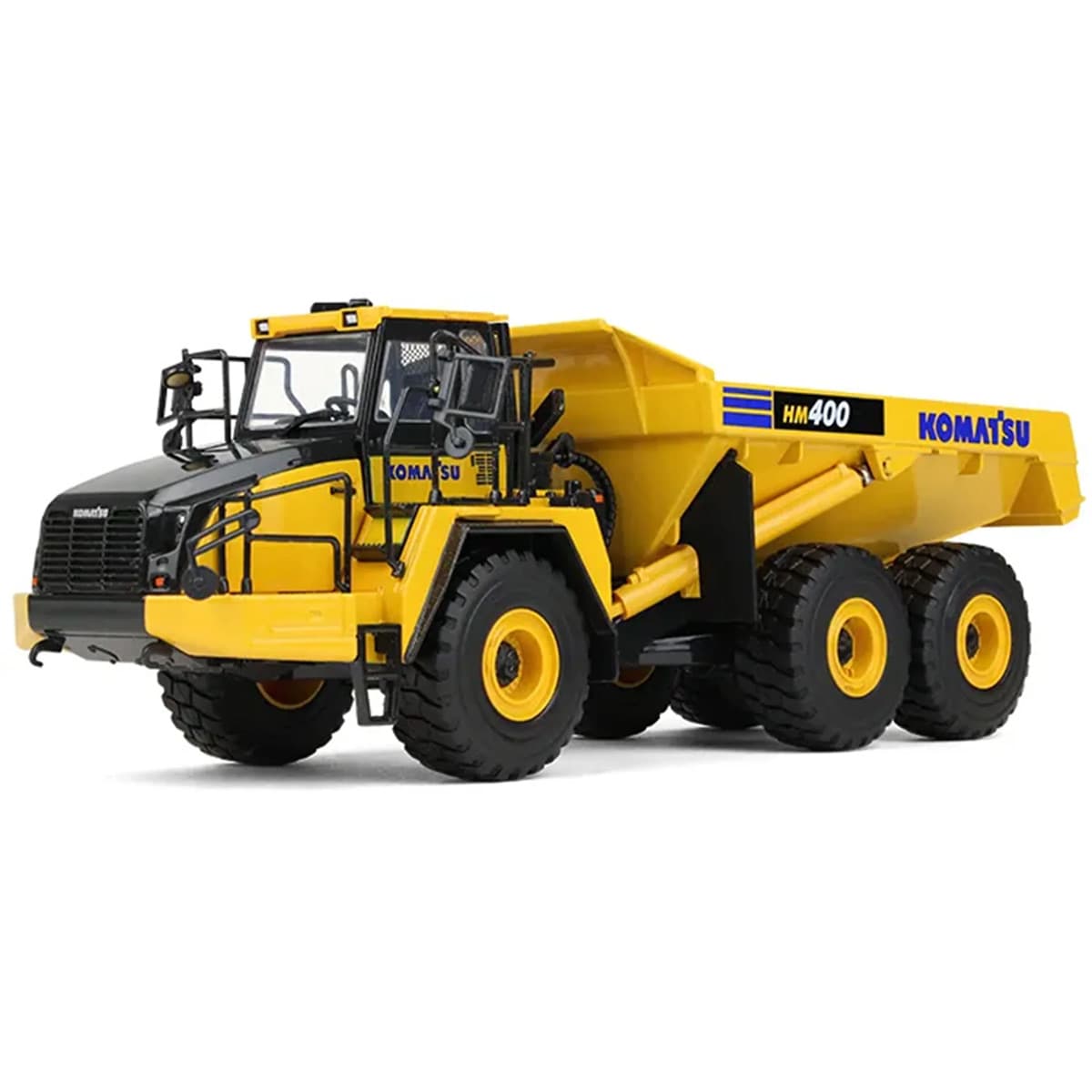
The dump truck has a rigid chassis and road tires: on wet clay, on freshly placed fill or on a dirt ramp, it loses traction and gets stuck. In the rainy season that's the rule, not the exception, on Central American sites. The articulated hauler keeps its wheels on the ground even on uneven terrain, because it pivots in the middle, and drives all of them: according to Komatsu, the HM400-3M0 has permanent 6x6 drive, hydropneumatic front suspension and carries 40 t.
Rule of thumb: if your internal roads turn to mud in the rain or have steep ramps, the articulated hauler keeps production up; if a dump truck needs towing twice a day, it's already costing you more than the right truck.
Firm road and lots of volume: the rigid off-highway truck
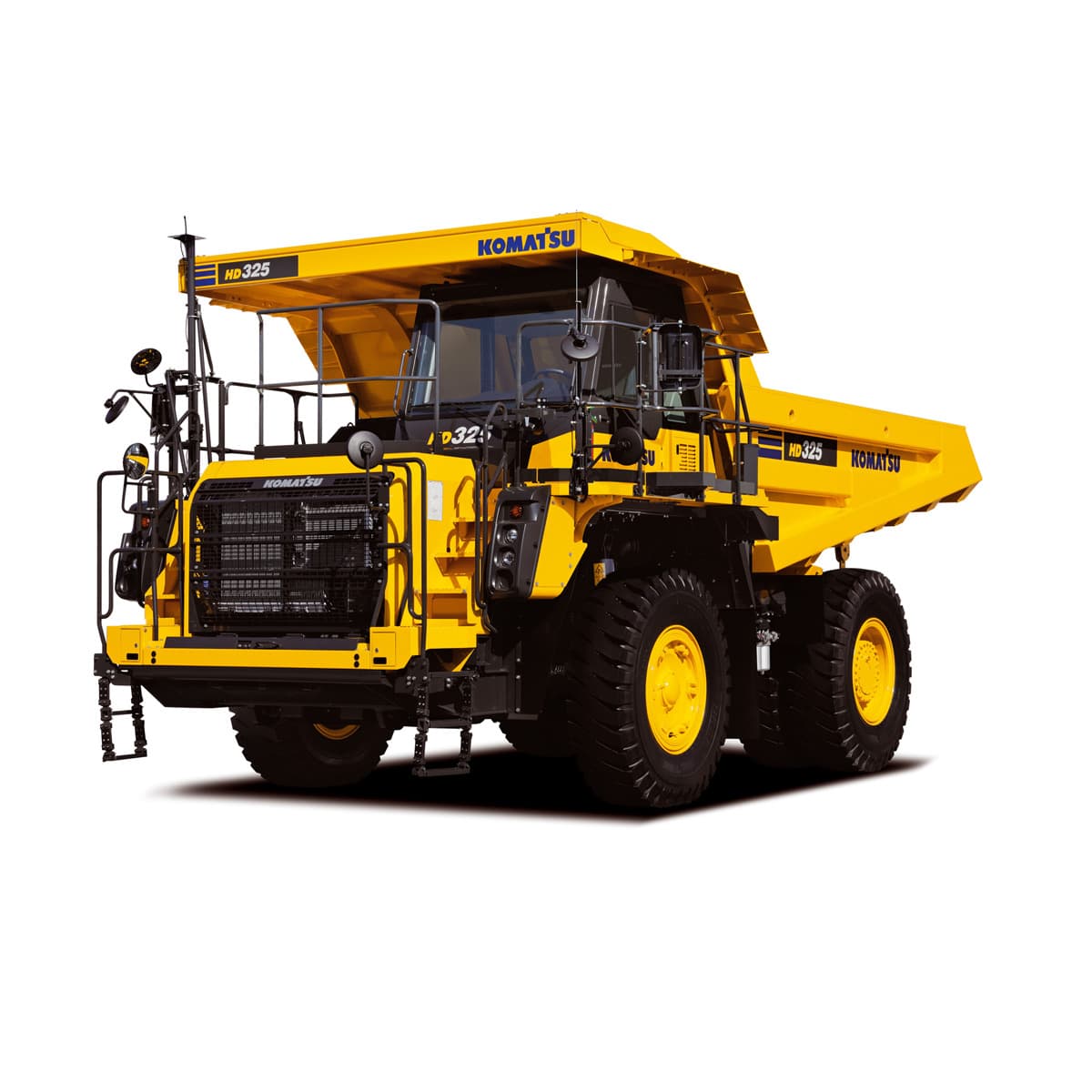
When the internal road is built and maintained with a motor grader, the rigid truck moves more per cycle and faster. According to Komatsu's datasheets, the HD325-7 carries 36.5 t in a 24 m³ body, the HD405-7 carries 45 t at up to 70 km/h and the HD465-7 carries 55 t in a heaped 34.2 m³ body. It's the truck for quarries, mines and large earthmoving with a stable road. The mining guide explains how it pairs with the excavator that loads it.
Payload: tonnes and cubic meters
Payload is measured in tonnes; the body, in cubic meters. Which fills first depends on the material's weight. The HM400-3M0 carries 40 t in 24 m³: with material heavier than about 1.7 t per cubic meter (40 ÷ 24), you hit the weight before filling the body; with lighter material, you fill the body before the weight. Get your material's weight and do the math before comparing trucks.
For a dump truck, how much you can carry on the road is set by your country's weight rules, not just the truck: confirm it with the traffic authority.
- D'Avino D6 dumper: 6 t
- D'Avino D12 dumper: 12 t
- HM400-3M0 articulated: 40 t
- HD465-7 rigid: 55 t
- Source: D'Avino and Komatsu datasheets in the catalog.
Small site or tight space: the site dumper
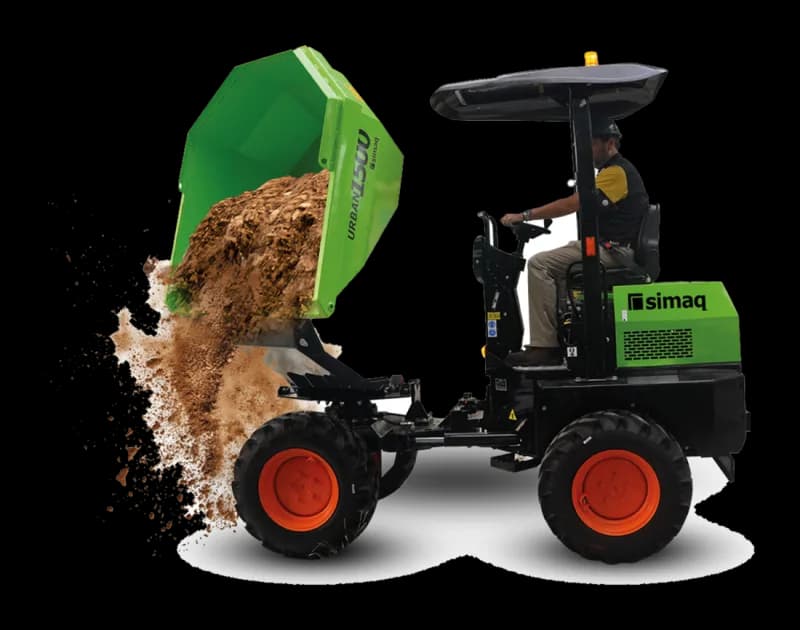
Between the wheelbarrow and the truck there's a step many sites skip. The site dumper carries material inside the site where a truck can't go: between buildings, through narrow access or next to a trench. According to D'Avino, the D6 carries 6,000 kg and the D8 8,000 kg with the same 6,100-liter heaped body, both with a swivel dual-view seat and grades up to 50%; the D12 carries 12,000 kg and steers all four wheels in crab mode to pull up to a wall or trench without maneuvering. They're offered in El Salvador and Guatemala. In all four countries, the SIMAQ Urban 1500 is a compact 4x4 dumper for moving material where trucks can't reach.
What the group offers, and what it doesn't
To be clear: the group's catalog doesn't include road dump trucks. It offers Komatsu's HM400-3M0 articulated hauler and HD325-7, HD405-7 and HD465-7 rigid trucks in all four countries, D'Avino site dumpers in El Salvador and Guatemala, and the SIMAQ Urban 1500 in all four. If your hauling is by road, get the dump truck from a truck dealer; the group does offer the excavator or wheel loader that loads it, like the Komatsu PC200-10M0, which per its datasheet is the 20 t class meant also for loading dump trucks.
Many jobs combine both worlds: articulated or rigid trucks inside, and dump trucks to take surplus material out by road.
How many trucks and where to quote them
The number of trucks is set by the cycle, not intuition: load, travel, dump and return time against the time the excavator takes to fill each one. With too few, the excavator waits; with too many, trucks queue. The group's fleet study compares alternatives with your distances, material and shifts.
Komatsu trucks are quoted in El Salvador (Zaragoza, Antiguo Cuscatlán, San Miguel), Guatemala as CMARKET (Mixco, Río Hondo, Xela), Nicaragua (Managua) and Panama (Panama City), with KOMTRAX, genuine parts and workshop or on-site service. State in the quote the material, haul distance, grade and whether the road is dirt or firm.
Summary: what to choose
| If… | Then… |
|---|---|
| Material goes out on streets or highways | Dump truck |
| You haul on site with mud or ramps | HM400-3M0 articulated hauler |
| Firm internal road and big volume | HD325-7 to HD465-7 rigid |
| Tight space or short haul | D'Avino dumper or SIMAQ Urban 1500 |
| Both inside and outside the site | Articulated inside, dump trucks outside |
| You don't know how many trucks | Fleet study |
Get a quote without leaving
Want to work it out with an advisor?
Topic: Articulated or rigid truck
Which country is your project in?
Common mistakes
Dump truck in mud
It gets stuck, needs towing and the front stops.
Articulated hauler to take material out by road
It isn't meant for public roads; that's dump-truck work.
Comparing tonnes only
With light material the body fills before the weight; check both.
Forgetting the internal road
A broken road slows any truck; maintain it with a grader.
Too many or too few trucks
Work out the cycle before buying or hiring.
Frequently asked questions
What's the difference between an articulated hauler and a dump truck?
The dump truck is a road truck with a tipping body, for public roads. The articulated hauler pivots in the middle and drives all wheels, for hauling inside the site in mud, soft ground or on grades.
Can an articulated hauler drive on the highway?
It isn't meant for public roads: between sites it travels on a lowboy. If you need to cross a road, check your country's rules with the traffic authority.
How much does an articulated hauler carry?
The Komatsu HM400-3M0 carries 40 t in a 24 m³ body, per its datasheet. With light material, the body fills before reaching the weight.
Do you sell dump trucks?
No: the catalog doesn't include road dump trucks. The group offers Komatsu articulated and rigid trucks for off-highway hauling, site dumpers, and the excavators and loaders that load dump trucks.
How much does an articulated hauler cost?
It depends on configuration, extended warranty, service contract and how you pay. Request a quote with your material and distances; an advisor will contact you during business hours.
Ready for the next step?
Work out how many trucks you need: fleet study