Short answer
There's no fixed number: it depends on your material and your site. You calculate it by multiplying the bucket capacity (from the datasheet) by the material's fill factor, by the cycles per hour you time on site and by the shift efficiency. That gives loose cubic meters per hour; if your plan or contract is measured in bank cubic meters, convert them with the material's densities.
The formula: four numbers
It's the standard method to estimate an excavator's output, for any brand. Two numbers come from the machine and the material; the other two only your site can give you.
- Bucket capacity: m³, from the datasheet
- × fill factor: Depends on the material
- × cycles per hour: 3,600 ÷ measured cycle in seconds
- × efficiency: Productive minutes ÷ 60
- = loose m³ per hour: Convert to bank or tonnes
1. Bucket capacity comes from the datasheet
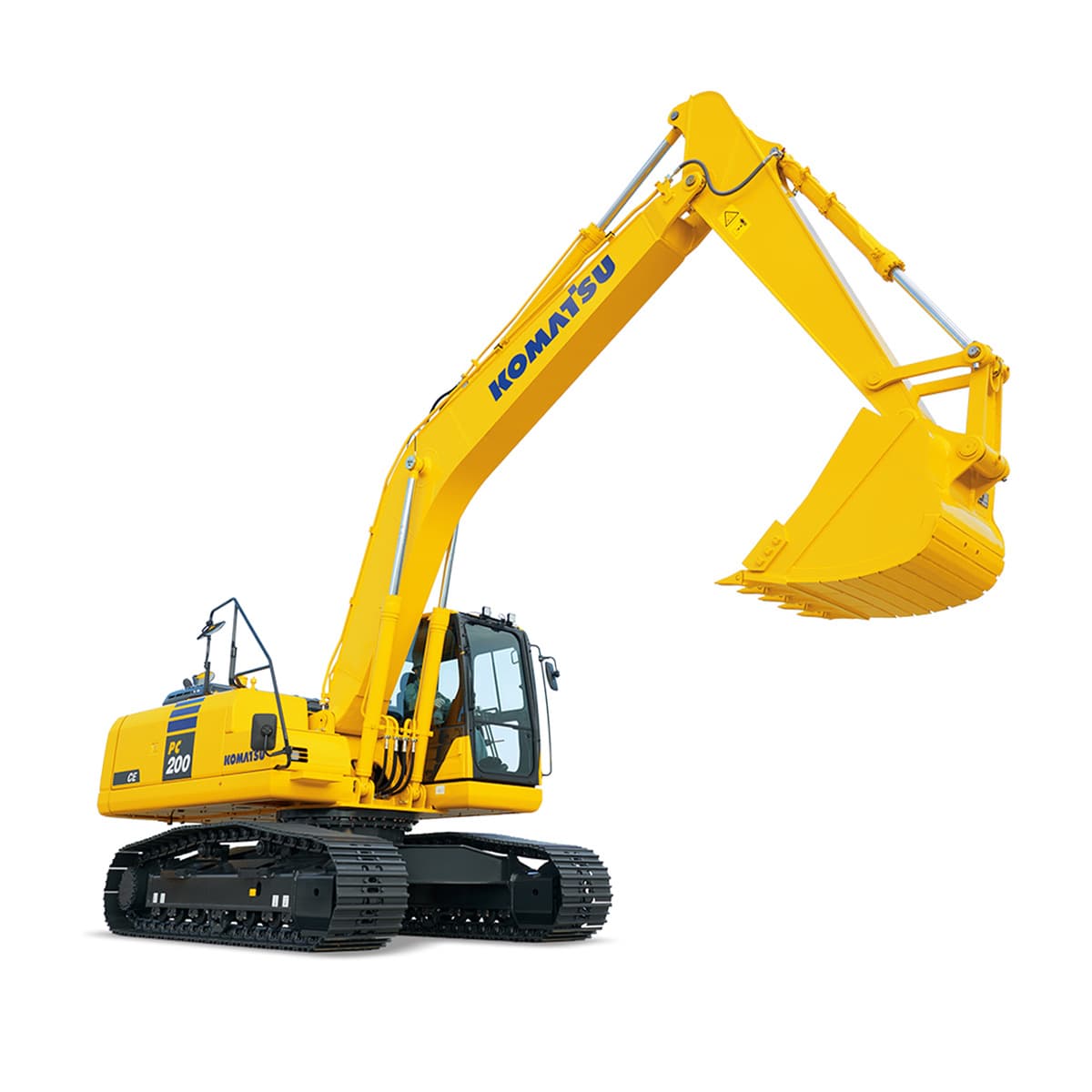
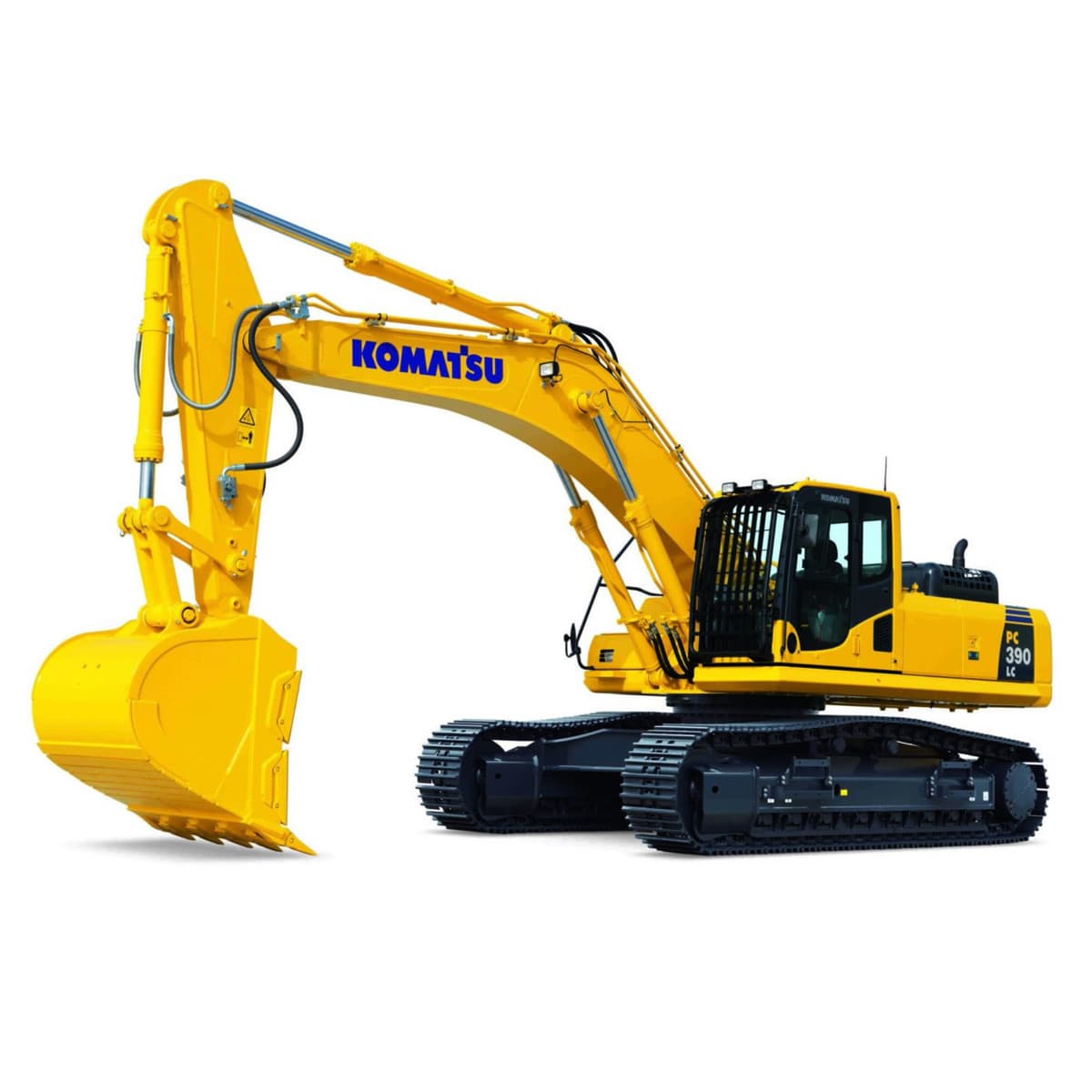
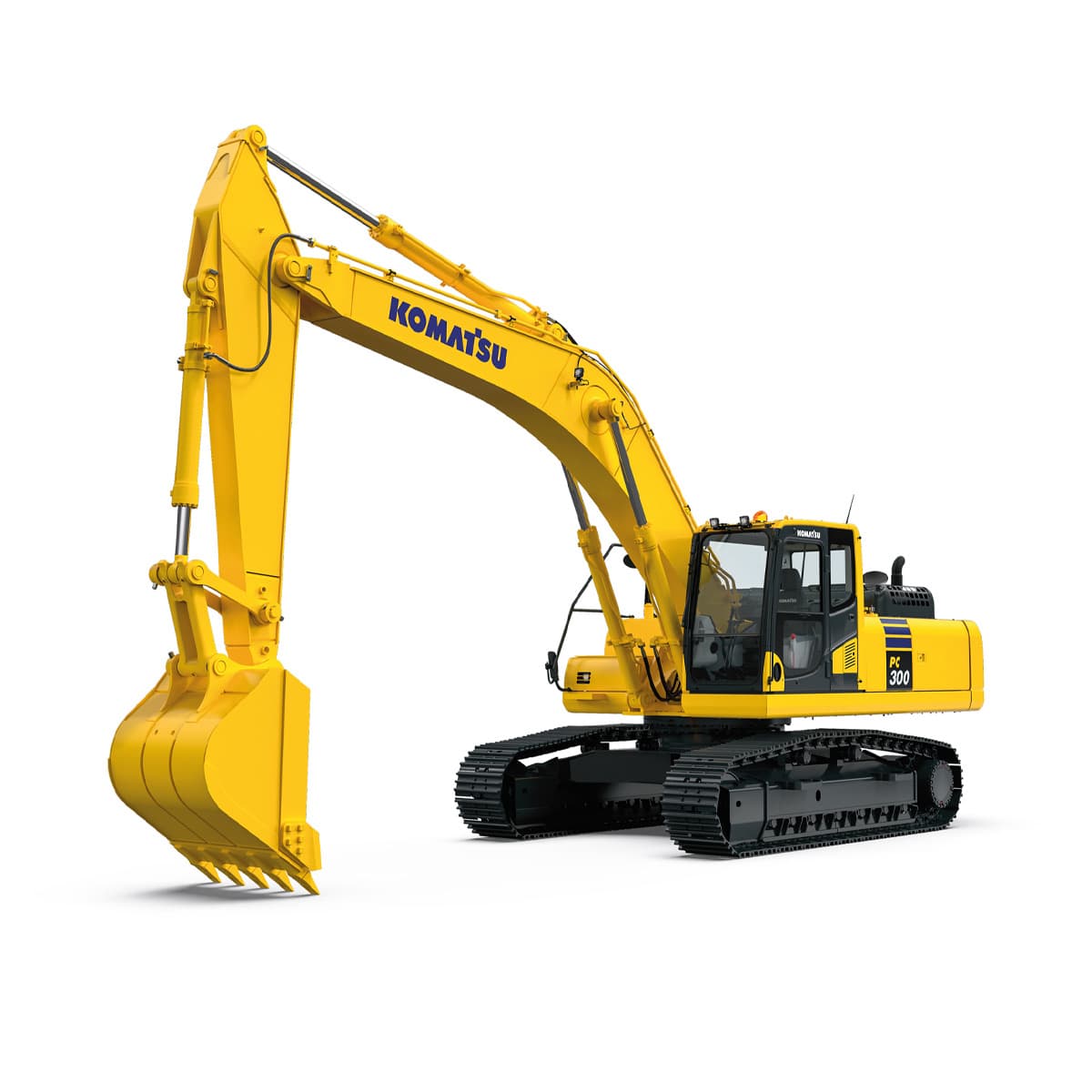
Use the capacity of the bucket your machine actually carries, not another configuration's. In the catalog, according to Komatsu's datasheets, the PC130-8 carries 0.5 m³, the PC200-10M0 and PC210-10M0 1.0 m³, the PC220LC-8 1.2 m³, the PC300-8M2 1.96 m³ (SAE rated), the PC360-8M2 2.23 m³ and the PC390LC-8M0 2.4 m³ with the standard bucket or 1.7 m³ with the rock bucket.
That figure is heaped and depends on the rating standard (the bucket guide explains it): it's just the starting point.
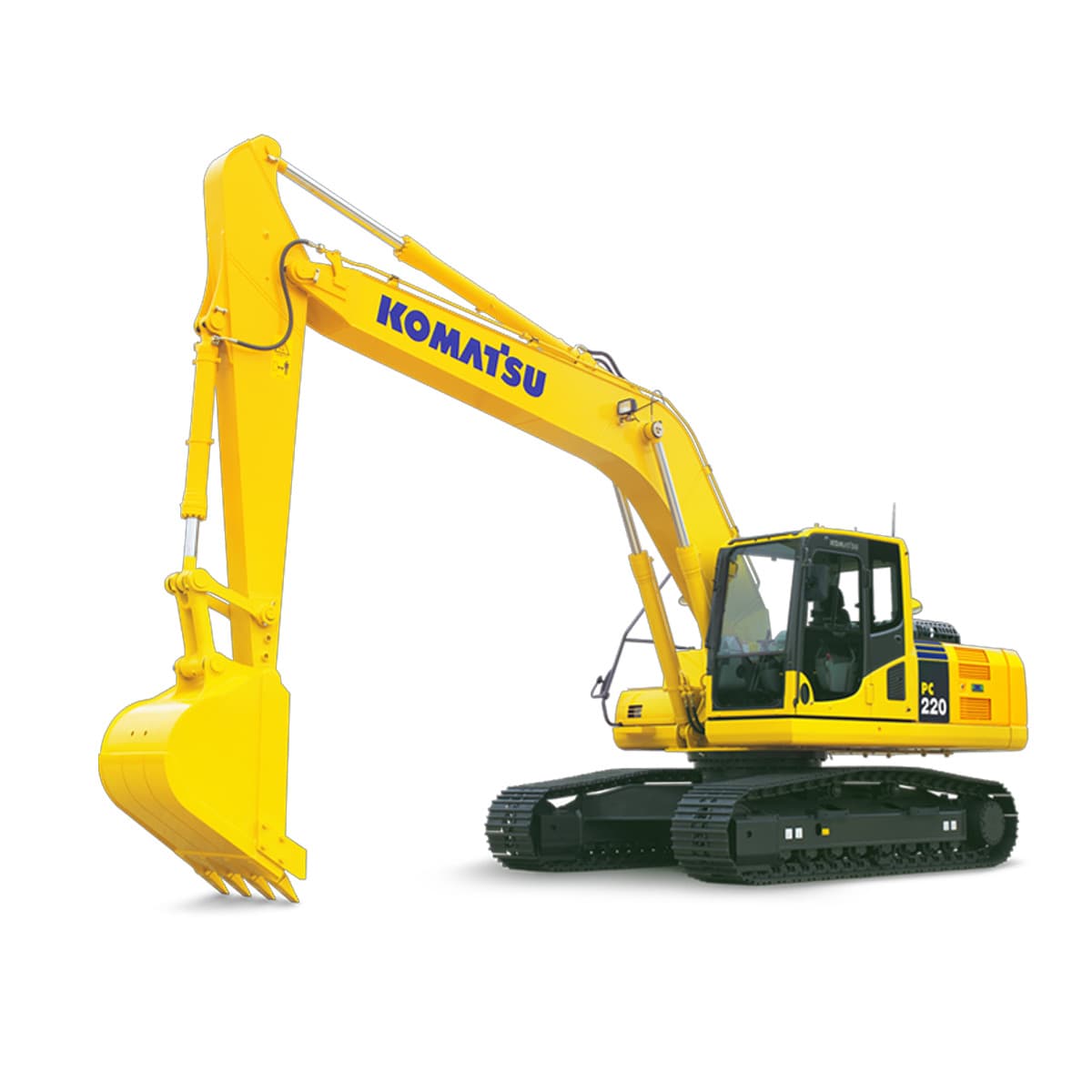
- PC130-8: 0.5 m³
- PC200-10M0: 1 m³
- PC220LC-8: 1.2 m³
- PC300-8M2 (SAE): 1.96 m³
- PC360-8M2: 2.23 m³
- PC390LC-8M0 (standard): 2.4 m³
- Source: Komatsu datasheets in the catalog.
2. The fill factor depends on the material
A 1 m³ bucket almost never digs out 1 m³. The site's bucket table uses these fill factors, which are the industry standard:
- Mud and saturated soil: 1.05 (it heaps).
- Common earth, sand and gravel: 1.0.
- Hard, compacted clay: 0.85.
- Well-fragmented rock: 0.7.
- Poorly fragmented rock: 0.45 — fills less than half.
3. Cycles per hour are measured with a stopwatch
The cycle is the time the machine takes to load, swing loaded, dump and come back. It's the number that moves the result the most and the only one not on any datasheet: it depends on the swing angle, the cut depth, where the truck stands, the material's hardness and the operator. That's why you measure it on your site instead of copying it from another.
Cycles per hour = 3,600 ÷ average cycle in seconds.
- Start the stopwatch when the bucket enters the material and stop it when it enters again.
- Time 20 to 30 cycles in a row and average them; a single one misleads.
- Measure the real job: the same depth, the same swing and the same truck you'll use.
- Log waits separately (a truck that doesn't arrive, repositioning the machine): they go into efficiency, not the cycle.
4. Efficiency: the minutes it really works
No machine works 60 minutes of every hour: truck waits, moves, operator changes and breaks eat part of the shift. Measure it like the cycle: watch for an hour and count the minutes the machine was digging and loading. If it was 45, your efficiency is 45 ÷ 60 = 0.75.
Telematics helps measure it across the whole shift. On Komatsu, KOMTRAX records real hours and idle time, and Komatsu's 3D guidance (3DMG) adds a payload meter that weighs what each bucket lifts, on excavators up to the PC490, according to Komatsu. In haul fleets, Smart Construction Fleet records each truck's cycle times.

5. Bank or loose cubic meters?
When dug, material swells: the same weight takes up more volume. The formula gives loose cubic meters, which is what the bucket and the truck carry. But the cut on the drawing and many contracts are measured in bank cubic meters, the ground in place. Mixing them up inflates output.
The conversion comes from densities: bank m³ = loose m³ × loose density ÷ bank density. With the densities from Komatsu's Specifications & Application Handbook used in the bucket table, rock goes from 2.8 t/m³ in the bank to 1.6 loose: each loose cubic meter of rock is only 0.57 bank m³. If your material isn't in the table, weigh it: fill the bucket, weigh the load and divide by the volume.
| Criterion | Topsoil | Hard clay | Rock |
|---|---|---|---|
| Bank (t/m³) | 1.37 | 1.8 | 2.8 |
| Loose (t/m³) | 0.95 | 1.45 | 1.6 |
| 1 loose m³ = | 0.69 bank m³ | 0.81 bank m³ | 0.57 bank m³ |
6. Worked example (with assumptions)
Illustrative example with assumptions, not a promise of output. Machine: Komatsu PC200-10M0, 1.0 m³ bucket according to its datasheet. Material: hard clay, fill factor 0.85, loose density 1.45 t/m³ and bank density 1.8 t/m³ (bucket table). Assume you timed 30 cycles and the average was 24 seconds, and that in the observed hour the machine worked 45 minutes.
Cycles per hour: 3,600 ÷ 24 = 150. Output: 1.0 × 0.85 × 150 × 0.75 = 95.6 loose m³ per hour. By weight: 95.6 × 1.45 = 138.7 t per hour. In bank terms: 138.7 ÷ 1.8 = 77.0 m³ per hour.
Now change a single figure: if the truck is badly placed and the cycle rises to 30 seconds, you get 120 cycles and 76.5 loose m³ per hour, 20% less with the same machine. That's why the cycle is measured and looked after.
7. How to raise output without changing machines
What improves output shortens the cycle or raises efficiency; going up a bucket size without checking stability is a mistake (the bucket guide explains it).
- Position the truck so the swing is short and dumping doesn't force extra lifting.
- Have the next truck ready: an excavator that waits has low efficiency even with a good cycle.
- Use the right bucket and teeth for the material: a bucket that doesn't penetrate lengthens every cycle.
- Train the operator: the group's APMT Academy runs the basic excavator course.
- Check idle time in KOMTRAX: engine hours without output lower efficiency and raise cost.
8. From m³ per hour to cost per m³ and to the fleet
Output per hour is half the math. Divide the machine's cost per hour by its output and you get the cost per cubic meter, which is what you quote a job with; the site's cost-per-hour calculator gives you a first figure. When the excavator loads trucks, its output also depends on how many trucks there are and how long they take to come back: with too few, it waits; with too many, they queue. A fleet study solves that: it measures your cycles and haul routes and compares alternatives by cost per tonne.
Grupo ConstruMarket is Komatsu's authorized distributor in El Salvador (Zaragoza, Antiguo Cuscatlán, San Miguel), Guatemala as CMARKET (Mixco, Río Hondo, Xela), Nicaragua (Managua) and Panama (Panama City), with excavators from the PC130-8 to the PC1250-11R in all four countries.
Summary: what to choose
| If… | Then… |
|---|---|
| You need a figure to quote a job | Time the cycle on your site; don't copy it |
| The plan or contract pays bank m³ | Convert with loose density ÷ bank density |
| You dig hard clay or rock | Fill factor from 0.85 down to 0.45 |
| The excavator waits for trucks | The bottleneck is the fleet: fleet study |
| The cycle is long because of the swing | Reposition the truck before changing machines |
| You want the cost per m³ | Cost per hour ÷ output per hour |
Get a quote without leaving
Want to work it out with an advisor?
Topic: Excavator
Which country is your project in?
Common mistakes
Taking bucket capacity as output
Without fill factor or efficiency, the figure is inflated from the first step.
Copying the cycle from another site or a brochure
Swing, depth, truck and operator change the cycle; only yours counts.
Mixing bank and loose m³
In rock, one loose m³ is only 0.57 bank m³: the gap is huge.
Counting 60-minute hours
Waits and moves happen; if you don't deduct them, you promise what you won't move.
Timing three cycles and calling it done
With few cycles the average misleads; time 20 to 30 in a row.
Frequently asked questions
How many m³ per hour does a 20-tonne excavator move?
It depends on the material, the cycle and your site's efficiency. In this guide's example, a PC200-10M0 with a 1.0 m³ bucket in hard clay, with an assumed 24 s cycle and 45 useful minutes per hour, gives 95.6 loose m³ or 77 bank m³ per hour. With your measured data, the figure will differ.
How do you calculate an excavator's output?
Bucket capacity × fill factor × (3,600 ÷ cycle in seconds) × efficiency. The result is loose m³ per hour; for bank m³ multiply by loose density ÷ bank density.
What is material swell?
It's the increase in volume when digging: loose material takes more space than in place. According to the Komatsu densities in the bucket table, rock goes from 2.8 t/m³ in the bank to 1.6 loose, and hard clay from 1.8 to 1.45.
How long is an excavator cycle?
There's no figure that fits every site: it changes with the swing, depth, truck position, material and operator. Time 20 to 30 cycles on your real job and use the average.
How many passes does it take to fill a truck?
Divide the truck's capacity by the load per pass (bucket × fill × loose density). With 1.0 m³ in hard clay that's 1.0 × 0.85 × 1.45 = 1.23 t per pass; check the total doesn't exceed what the truck is rated for.
Is there an excavator productivity calculator?
The site has the cost-per-hour calculator; output is calculated with this method. For a loading and hauling fleet, the fleet study models output and cost per tonne with your data.
Ready for the next step?
Request a fleet study