
Short answer
Under OSHA's excavation standard (US), every trench 1.52 m (5 ft) or deeper with people inside needs cave-in protection: a slope, shoring or a shield, except in stable rock. The slope depends on the soil: ¾:1 (53°) in Type A, 1:1 (45°) in Type B and 1½:1 (34°) in Type C, up to 6.1 m deep; deeper, an engineer designs it. Each country has its own standard and this guide doesn't replace it.
Simulator: dig the trench and see what happensWhy OSHA's standard is used
A trench wall caves in without warning and soil is heavy: whoever is underneath can't get out alone. That's why standards don't say "when" a wall falls, but from what depth there must be protection and how it's designed.
The most complete public reference is from the US Occupational Safety and Health Administration (OSHA): federal regulation 29 CFR 1926, Subpart P, "Excavations", free to read on osha.gov. It has the rule for when to protect (1926.652), the general requirements (1926.651), soil classification (Appendix A) and the slope table (Appendix B). This guide's figures come from there, with the metric conversion OSHA itself publishes.
Before going on: it's a US standard. In your country, yours rules (at the end of the guide, what exists in El Salvador, Guatemala, Nicaragua and Panama). This guide teaches the logic; it doesn't replace the local standard, the soil study or the competent person on site.
From what depth you must protect: 1.52 m
OSHA 1926.652(a)(1): every worker in an excavation must be protected from cave-ins by an adequate system, with two exceptions:
First, the excavation is entirely in stable rock. Second, it's less than 5 feet (1.52 m) deep and a competent person has examined the ground and found no indication of a potential cave-in.
Mind the second one: it doesn't say a 1.4 m trench is safe. It says that below 1.52 m you may work without protection only if someone able to recognize the hazard checked it. If there are cracks or sloughing, you protect it anyway. And with water in the trench, 1926.651(h)(1) applies on its own: nobody works inside without precautions such as shoring or a shield, dewatering or a harness, at any depth.
What depth and what ground?
- All in stable rock → No protection required
- Under 1.52 m and the competent person sees no signs → No protection required
- Under 1.52 m with cracks, sloughing or water → Protect it (with water, 1926.651(h)(1))
- 1.52 m or more → Slope, shoring or shield
First, classify the soil: A, B or C
The slope depends on the soil, and OSHA's Appendix A classifies it in four classes, from most to least stable: stable rock, Type A, Type B and Type C. A competent person classifies it with visual and manual tests (or lab tests), and if conditions change, it's reclassified.
What's most often forgotten: water and vibration lower the class. A soil that would be A stops being so if it's fissured, gets vibration from heavy traffic or pile driving, or was previously disturbed. And any submerged soil or soil with water seeping out is Type C.
- Type A: cohesive soils (clay, silty clay, sandy clay) with unconfined compressive strength of 144 kPa (1.5 tsf) or more; also cemented soils like caliche. Never A if fissured, vibrated, disturbed or in layers dipping into the trench.
- Type B: cohesive soils above 48 kPa and below 144 kPa; granular soils like angular gravel, silt and sandy loam; previously disturbed soils; or an A with fissures or vibration.
- Type C: cohesive soils of 48 kPa or less; granular soils like gravel, sand and loamy sand; submerged soil or soil with water seeping out.
- Stable rock: solid mineral matter that can be dug with vertical sides and stays intact.
Each soil's slope: ¾:1, 1:1 and 1½:1
Slope is written as horizontal : vertical. "1:1" means that for every metre down, the wall opens one metre out. Table B-1 in OSHA's Appendix B gives the steepest slope allowed for excavations under 20 feet (6.1 m):
Stable rock, vertical (90°). Type A, ¾:1 (53°). Type B, 1:1 (45°). Type C, 1½:1 (34°).
Three nuances from the same table. One: in Type A, a trench 12 feet (3.67 m) or less that's open 24 hours or less may go to ½:1 (63°). Two: if signs of distress appear (cracks, edge subsidence, sloughing), the slope is flattened by at least ½ more (in Type C, from 1½:1 to 2:1 (27°)), and the under-1.52 m exemption no longer applies. Three: if there are loads near the edge — stockpiled spoil, working machines or traffic — the competent person decides how much flatter it goes.
And if you don't classify the soil, OSHA 1926.652(b)(1) gives the conservative way out: a 1½:1 (34°) slope, Type C's, in any soil.
| Criterion | Type A | Type B | Type C |
|---|---|---|---|
| Slope (H:V) | ¾:1 | 1:1 | 1½:1 |
| Angle from horizontal | 53° | 45° | 34° |
| Opens per metre of depth | 0.75 m per side | 1 m per side | 1.5 m per side |
Deeper than 6.1 m: an engineer designs it
The slope table holds for excavations under 20 feet (6.1 m). Deeper, note 3 of Table B-1 is clear: a registered professional engineer designs the slope or benches, and the design stays in writing on site.
OSHA 1926.652(b) gives four ways to design the slope: 1½:1 for everything, the Appendix A and B table, other tables approved by an engineer, or an engineer's own design. The last two require the signed copy on site while the work is done.
Shoring and shields: when there's no room for the slope
On a narrow street, next to a house or with utilities alongside, the slope doesn't fit: in Type C soil, a 2.5 m deep trench at 1½:1 opens 3.75 m on each side. That's where shoring (struts and boards holding the wall) or a trench shield (a steel box lowered into the trench that protects whoever works inside) comes in.
OSHA 1926.652(c) requires shoring and shields to be designed from the manufacturer's tabulated data (its tables by depth and soil type), the standard's Appendices C and D, or an engineer's design. And it sets usage rules that don't change with the brand: nobody inside the shield while it's being installed, removed or moved vertically; digging up to 2 feet (0.61 m) below the shield is allowed only if it's designed for the full depth and there's no sign of soil loss; shoring is removed from the bottom up and backfilled as it comes out.
How much extra earth the slope moves
The slope protects, but you pay for it in cubic metres: everything that opens at the top has to be dug, hauled and later backfilled. The math is geometry:
m³ per metre of trench = bottom width × depth + slope × depth².
The first term is the vertical-wall trench; the second, the extra earth the slope asks for (the two side triangles).
Example with assumed measurements: 0.6 m bottom and 2.5 m deep. With vertical walls it would be 1.50 m³ per metre. With the standard's slope: Type A (¾:1), 6.19 m³ and 4.35 m wide at the top; Type B (1:1), 7.75 m³ and 5.6 m; Type C (1½:1), 10.88 m³ and 8.1 m. In C soil, a 100 m trench moves 1,088 m³ instead of 150: over seven times as much. That's why in poor soil, or when there's no room, a trench shield often costs less than the slope.
- Vertical (with shield): 1.5 m³/m
- Type A · ¾:1: 6.19 m³/m
- Type B · 1:1: 7.75 m³/m
- Type C · 1½:1: 10.88 m³/m
- Slopes: OSHA 1926 Subpart P, Table B-1. Example measurements: assumed.
Ladder, spoil and daily inspection
Three rules from OSHA 1926.651 that hold with any protection:
Way out: in trenches 4 feet (1.22 m) or deeper there must be a ladder, ramp or stairway within 25 feet (7.62 m) of lateral travel from every worker (1926.651(c)(2)).
Spoil: excavated material, tools and equipment are kept 2 feet (0.61 m) or more from the edge, or behind a stop that holds them (1926.651(j)(2)). Earth piled at the edge falls back in and also loads the wall.
Inspection: a competent person checks the excavation, its surroundings and the protection every day before starting, during the shift as needed and after every rainstorm (1926.651(k)(1)).
- Ladder or ramp from 1.22 m deep, within 7.62 m of every worker.
- Spoil, tools and machines 0.61 m or more from the edge.
- Daily check before starting and after every rainstorm.
- Nobody works on the slope above someone else without protection from falling material (1926.652(f)).
Which excavator for trenching
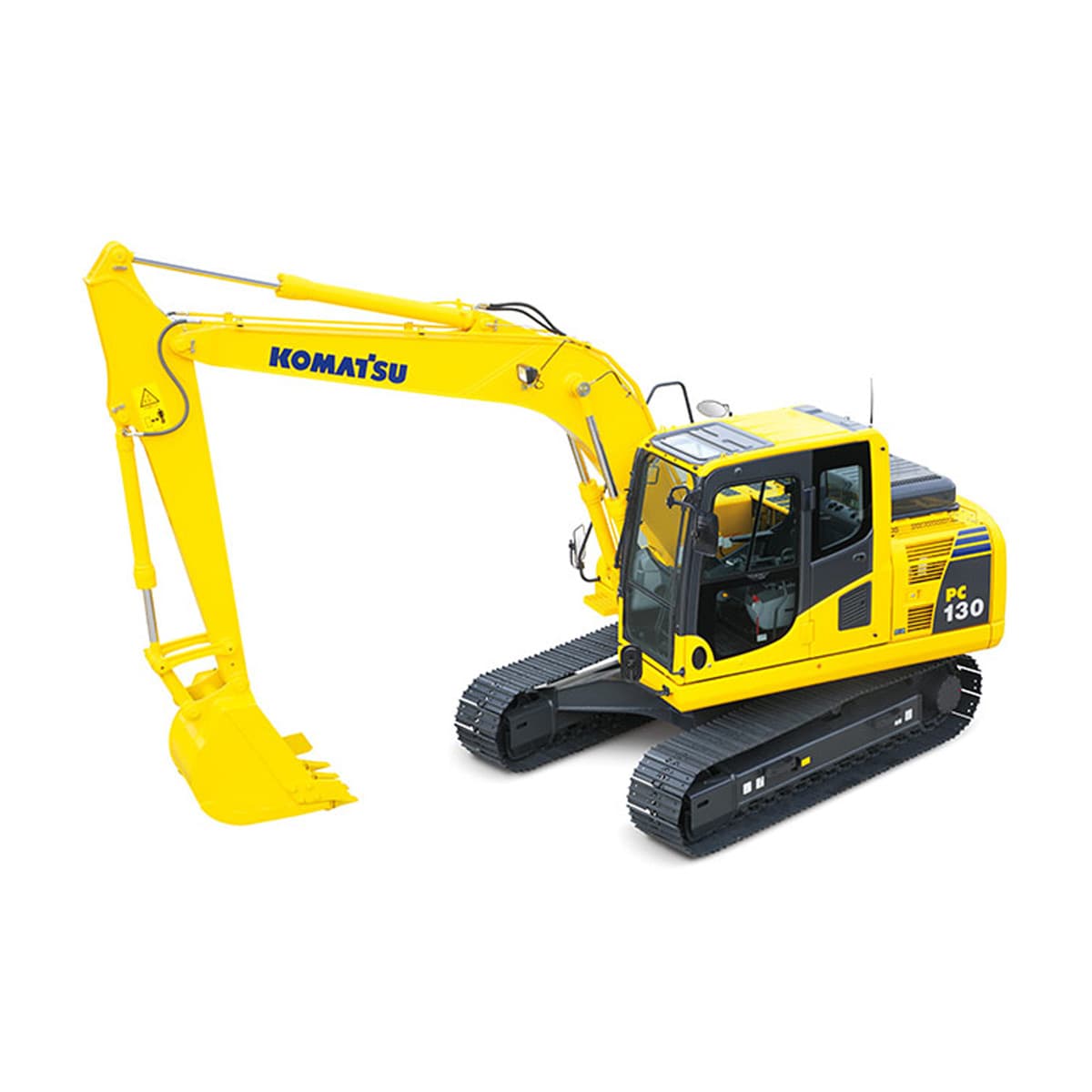
For a trench, the first datasheet figure is maximum digging depth: it has to exceed your trench bottom, and not right at the limit, because at the limit the machine works stretched out and loses force. According to Komatsu's datasheets in the catalog, the PC130-8 digs to 5.52 m, and the PC200-10M0 and PC210-10M0 to 6.62 m. For utilities on narrow streets the PC130-8 is the class to use; for deeper trenches or a bigger bucket, the 20 t class.
The excavator is also a load near the edge: OSHA asks the competent person to decide how much flatter the slope goes when machines work nearby. And its bucket isn't protection: nobody gets into the trench "because the bucket's there".
Grupo ConstruMarket is Komatsu's authorized distributor in El Salvador, Guatemala (as CMARKET), Nicaragua and Panama.
Each country has its own standard
OSHA is the US standard and it's used here because it's public, complete and the most cited. In Central America each country's standard rules and, on site, the project's safety plan. This guide doesn't replace it.
What each country where the group operates says (read on 13-Oct-2026; always check the version in force):
El Salvador — General Regulation on Risk Prevention in Workplaces (Executive Decree 89 of 2012), section on excavation work. Art. 330: if the ground isn't firm or the excavation is deeper than 1.50 m, slopes follow the angle of repose in its table (clean sand, 1.5 to 1, 33° 41´). Art. 331: sheet piling or bracing in excavations deeper than two metres or where the slope doesn't fit. Art. 334: stockpiles at half the depth or more, at least 0.6 m from the edge.
Guatemala — Occupational Health and Safety Regulation (Government Agreement 229-2014, amended by 33-2016). Art. 145: slope equal to the soil's natural angle, or shoring. Art. 146: from 0.80 m to 1.30 m, horizontal shoring in cohesive ground; from 1.50 m to 1.80 m, vertical shoring if it's not cohesive enough. Art. 148: spoil piled at least twice the depth away.
Nicaragua — Law 618, General Occupational Health and Safety Law (2020 consolidated text). Art. 248: a ground study before digging and, in every excavation deeper than 1.5 metres, slopes according to the ground or shoring. Art. 250: ladders every 15 metres and no spoil within 2 metres of the edge.
Panama — Executive Decree 2 of 2008 (MITRADEL), safety in the construction industry. Art. 112: excavations under 1.5 m (5 ft) checked by a competent person with no cave-in potential don't need protection. Art. 118: excavated material 0.6 m (2 ft) or more from the edge. Art. 130: in excavations under 6 m, maximum slope of 34° (1½ to 1), unless designed from tables or by an engineer.
As you can see, the figures don't match between countries: Guatemala requires shoring from shallower depths and piling farther away, and Nicaragua sends spoil 2 metres back. On your site, the strictest rule that applies to you governs.
Do it with your numbers
Dig your trench
Pick the soil and depth: if the wall caves in, one tap applies the standard's slope and you see the extra earth.
Summary: what to choose
| If… | Then… |
|---|---|
| The trench is 1.52 m or deeper | Slope, shoring or shield |
| You don't know the soil type | 1½:1 (34°) slope or a shield |
| Water seeps from the wall | It's Type C: 1½:1 (34°) |
| There's heavy traffic or vibration nearby | It can't be Type A |
| There's no room for the slope | Shoring or a trench shield |
| Deeper than 6.1 m | An engineer's design |
| Trench of 1.22 m or more | Ladder within 7.62 m |
Get a quote without leaving
Want to work it out with an advisor?
Topic: Trenching excavator
Which country is your project in?
Common mistakes
"It's shallow, it won't cave in"
Below 1.52 m the exemption only holds if a competent person checked and saw no signs.
Classifying the soil on Monday and forgetting it
Rain, water and traffic change the class: it's checked daily and after rain.
Piling spoil right at the edge
It falls back in and loads the wall: 0.61 m or more away.
Getting into the shield while it moves
Nobody inside while it's installed, removed or moved vertically.
Using the table for an 8 m trench
The table holds to 6.1 m; deeper, an engineer's design.
Take it to the job site
Print the checklist to go over it on site, or send the guide to your crew.
Frequently asked questions
From what depth must a trench be shored?
Under OSHA 1926.652(a)(1), from 5 feet (1.52 m) every trench with people inside needs protection: a slope, shoring or a shield, unless it's entirely in stable rock. Below 1.52 m it's exempt only if a competent person checked the ground and saw no sign of a cave-in. Also check your country's standard.
What slope angle does a trench need?
It depends on the soil. OSHA Table B-1: ¾:1 (53°) in Type A, 1:1 (45°) in Type B and 1½:1 (34°) in Type C, for under 6.1 m. If you don't classify the soil, use 1½:1 (34°).
How do I know if my soil is Type A, B or C?
A competent person classifies it with visual and manual tests (OSHA Appendix A). In short: firm clay without fissures or vibration is A; silt, angular gravel or previously disturbed soil is B; sand, loose gravel or any soil with water is C.
How much extra earth does the slope move?
Slope × depth² per metre of trench. With a 0.6 m bottom and 2.5 m deep, in Type C soil (1½:1) you go from 1.50 m³ per metre with vertical walls to 10.88 m³. The simulator calculates it with your measurements.
What is a trench shield?
A steel box lowered into the trench to protect whoever works inside, without cutting a slope. It's chosen from the manufacturer's tables for your depth and soil, and nobody goes in while it's placed or moved.
How far from the edge does the spoil go?
At least 2 feet (0.61 m) from the edge, or behind a stop that holds it (OSHA 1926.651(j)(2)).
Ready for the next step?
Get a quote for a trenching excavatorGrupo ConstruMarket · Job site checklist
Trench sloping and shoring: from what depth to protect and which angle to use
Under OSHA's excavation standard (US), every trench 1.52 m (5 ft) or deeper with people inside needs cave-in protection: a slope, shoring or a shield, except in stable rock. The slope depends on the soil: ¾:1 (53°) in Type A, 1:1 (45°) in Type B and 1½:1 (34°) in Type C, up to 6.1 m deep; deeper, an engineer designs it. Each country has its own standard and this guide doesn't replace it.
First, classify the soil: A, B or C
- Type A: cohesive soils (clay, silty clay, sandy clay) with unconfined compressive strength of 144 kPa (1.5 tsf) or more; also cemented soils like caliche. Never A if fissured, vibrated, disturbed or in layers dipping into the trench.
- Type B: cohesive soils above 48 kPa and below 144 kPa; granular soils like angular gravel, silt and sandy loam; previously disturbed soils; or an A with fissures or vibration.
- Type C: cohesive soils of 48 kPa or less; granular soils like gravel, sand and loamy sand; submerged soil or soil with water seeping out.
- Stable rock: solid mineral matter that can be dug with vertical sides and stays intact.
Ladder, spoil and daily inspection
- Ladder or ramp from 1.22 m deep, within 7.62 m of every worker.
- Spoil, tools and machines 0.61 m or more from the edge.
- Daily check before starting and after every rainstorm.
- Nobody works on the slope above someone else without protection from falling material (1926.652(f)).
Avoid
- "It's shallow, it won't cave in". Below 1.52 m the exemption only holds if a competent person checked and saw no signs.
- Classifying the soil on Monday and forgetting it. Rain, water and traffic change the class: it's checked daily and after rain.
- Piling spoil right at the edge. It falls back in and loads the wall: 0.61 m or more away.
- Getting into the shield while it moves. Nobody inside while it's installed, removed or moved vertically.
- Using the table for an 8 m trench. The table holds to 6.1 m; deeper, an engineer's design.
Job site:
Date:
Supervisor:
Scan it for the full guide, with video and FAQ
https://grupoconstrumarket.com/en/guias/talud-y-entibado-de-zanjas