
Short answer
Choose the backhoe by the deepest trench you'll dig repeatedly and by what you'll load with the front bucket: those two figures define the size. Then check hydraulic flow if you'll run a hammer, 4x4 drive if you work in mud or on slopes, and who gives you parts and a workshop in your country. Chosen well, a backhoe replaces a small loader and a mini excavator on spread-out jobs.
Watch it in 49 s
Why choose the Komatsu backhoe loader for your project?
Short video from Grupo ConstruMarket's channel.
Channel: GrupoConstrumarket
What a backhoe loader is and when it makes sense
A backhoe loader is a wheeled front loader with a digging arm at the back. It loads material at the front, digs at the rear and drives itself on the street from one front to the next. That mix makes it the typical machine for water and drainage networks, power lines, municipal maintenance, land subdivisions and urban work: jobs where the day combines trenching, backfilling, loading a truck and moving to another spot.
It isn't the best at any single task. If you dig all day on one front, a tracked excavator produces more, swings 360° and is more stable. If you only load and clean a yard, a wheel loader or a skid steer does it faster. The backhoe wins when you'd need two machines part-time and can't justify either one full-time.
1. Digging depth comes first
The figure that decides the most is the arm's maximum digging depth. Measure the deepest trench you'll repeat—pipe invert plus the sand bed—and add margin: working at the edge of reach is slower, less precise and forces you to lower the machine into the cut.
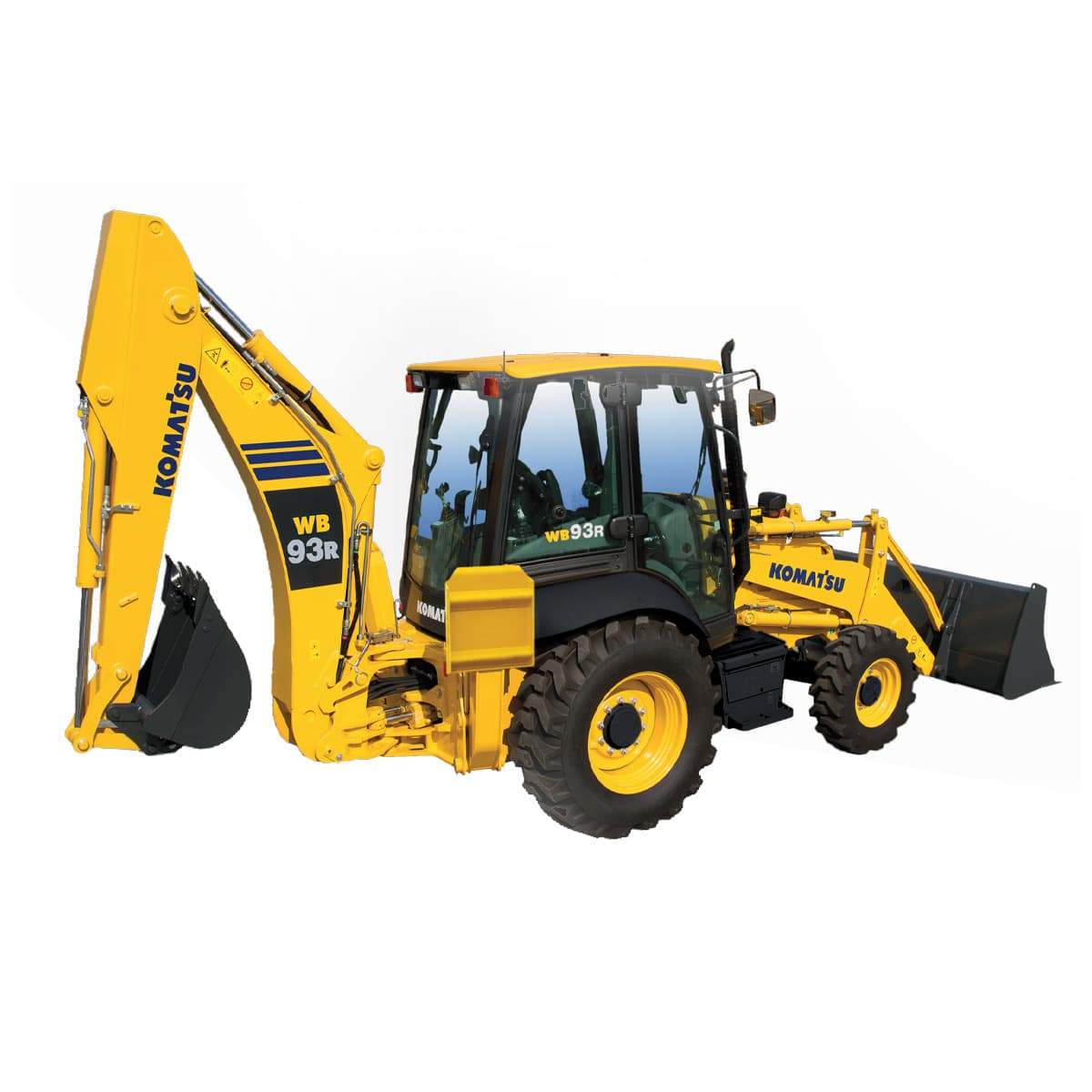
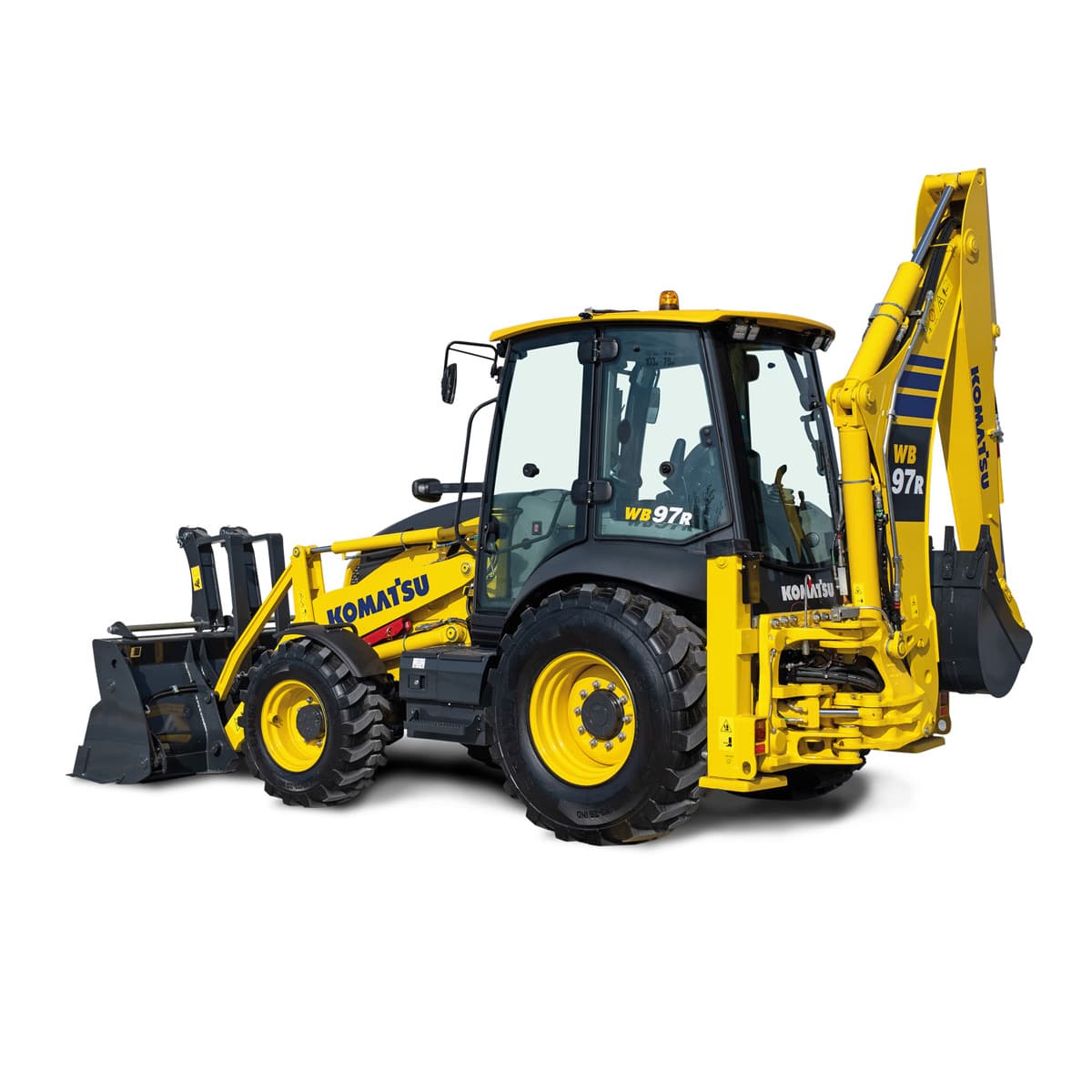
In the catalog, according to Komatsu's datasheets, the WB93R-5E0 digs down to a maximum depth of 4,977 mm and the WB97R-5E0 to 5,270 mm. That's almost 300 mm apart, and in a utility trench it's what separates reaching the bottom from the edge or having to step into it.
- Komatsu WB93R-5E0: 4,977 mm
- Komatsu WB97R-5E0: 5,270 mm
- Source: Komatsu datasheets in the catalog.
2. Front bucket and operating weight
The front bucket sets how much you move per pass when loading trucks or backfilling. Both carry 1.03 m³ (Komatsu datasheets), so between them the bucket isn't the deciding factor; against other backhoes, if loading is a big part of the day, bucket size and dump height matter as much as depth.
Operating weight—7.5 t for the WB93R and 7.6 t for the WB97R—adds stability when digging and lifting pipe, but it also counts when hauling the machine on a trailer and when driving over slabs or fresh pavement. More weight isn't better by itself: it's better if your work uses it.
| Criterion | WB93R-5E0 | WB97R-5E0 |
|---|---|---|
| Max. depth | 4,977 mm | 5,270 mm |
| Front bucket | 1.03 m³ | 1.03 m³ |
| Operating weight | 7.5 t | 7.6 t |
| Gross power (ISO 14396) | 99.2 HP | 99.2 HP |
| Hydraulic flow | 165 l/min | 165 l/min |
| Transmission and controls | Power Shuttle; PPC on the loader | Power Shift; PPC on loader and backhoe |
3. Hydraulics and attachments
If you'll mount a hydraulic hammer to break concrete or rock, the machine's flow and pressure must match what the hammer needs. Both backhoes in the catalog deliver 165 l/min according to Komatsu. Both use closed-center CLSS hydraulics; the WB97R-5E0 adds standard PPC servo controls on the backhoe too, which give finer movements when you work near existing pipes.
Before buying, list the attachments you'll use during the year—hammer, narrow trench bucket, forks—and ask for the quote to confirm the machine runs them without falling short. Speccing it from the factory is cheaper than retrofitting later.
4. Drive, cab and telematics
4x4 drive—standard on both—makes the difference in mud, in the rainy season and when climbing ramps with a loaded bucket. The outriggers must rest on firm ground before digging: a poorly stabilized backhoe loses precision and risks tipping when lifting to the side.
The cab matters more than it seems: the operator spends the whole shift there, and visibility toward the front bucket and into the trench means fewer hits on pipes. Both come with KOMTRAX built in: location, real hours, fuel use and alerts on your phone, useful to schedule maintenance by real hours and to know whether the machine spends more time idling than working.
Backhoe, excavator or skid steer: how to decide
The question isn't which machine is better, but what your job does most of the day. Use this flow as a first filter and confirm with real quantities: meters of trench per week, cubic meters to load and how many fronts you visit per day.
What does your job do most of the day?
- Trenches, backfill and loading at several fronts → Backhoe loader
- Bulk digging on one front → Tracked excavator
- Loading and cleanup in tight spaces → Skid steer
- A single project of a few months → Rent through RentaCentro
On site: what the work looks like
The best way to size a backhoe is to watch it work on a task like yours. This video from the group's channel shows a backhoe on site, switching between digging and loading.
Where to buy or rent a backhoe loader in Central America
Grupo ConstruMarket is Komatsu's authorized distributor in El Salvador, Guatemala (as CMARKET), Nicaragua and Panama, with genuine parts and workshop or on-site service. The WB93R-5E0 and WB97R-5E0 backhoes are in the catalog in all four countries. Price isn't public because it depends on configuration, attachments and payment method: request a quote with your application and an advisor will contact you during business hours.
If you need it for a single project, RentaCentro—a group company—has the WB93R in its rental fleet. And if you're buying, backhoes qualify for machinery financing (credit or leasing, subject to approval).
- El Salvador: Zaragoza (headquarters with workshop), Antiguo Cuscatlán and San Miguel.
- Guatemala (CMARKET): Mixco, Río Hondo and Xela.
- Nicaragua: Managua. Panama: Panama City.
Care for it every day: Komatsu's routine on video
Komatsu publishes on video the daily routine it asks of this machine's operators. Caring for it this way is what prevents unwanted stoppages and what backs up the warranty. What's specific to this machine:
- Before the shift: look for leaks, check the fuel pre-filter bowl (drain any water) and check the air filter indicator.
- Engine oil, hydraulic system, coolant, fuel and transmission oil levels.
- Check wear on the front and rear buckets, and grease every joint; Komatsu recommends grade 2 lithium-based grease.
- At the end, leave the stabilizers fully resting on flat ground, with no load on the hydraulic system, and 5 minutes at idle before shutting down.
- Daily inspection before operating a machine: the complete checklist
- Is your machine acting up? What to check yourself, by symptom, before calling the technician
Summary: what to choose
| If… | Then… |
|---|---|
| Your trenches reach ~4 m and you change fronts several times a day | WB93R-5E0-size backhoe |
| You need about 30 cm more depth and finer controls | WB97R-5E0 |
| You'll run a hydraulic hammer | Confirm flow and pressure against the hammer before buying |
| You dig all day on one front | Tracked excavator, not a backhoe |
| You only load and clean in tight spaces | Skid steer |
| You need it for a project of a few months | Rent through RentaCentro |
Get a quote without leaving
Want to work it out with an advisor?
Topic: Backhoe loader
Which country is your project in?
Common mistakes
Buying by horsepower
Both backhoes in the catalog share the same 99.2 HP engine; what sets them apart is depth, transmission and controls.
Not measuring the deepest trench
If the machine is just enough, every pass becomes slow and unsafe.
Using a backhoe as a production excavator
In bulk digging it produces less and wears faster than a tracked excavator.
Forgetting the hammer when quoting
Adapting the hydraulics later costs more than ordering it configured.
Ignoring parts and workshop
A stopped backhoe costs the workday; ask who stocks parts in your country.
Take it to the job site
Print the checklist to go over it on site, or send the guide to your crew.
Frequently asked questions
What's the best backhoe loader for construction work?
The one that reaches your deepest trench with margin, loads what you need per pass and has parts and a workshop in your country. In the catalog, the Komatsu WB93R-5E0 covers most utility work and the WB97R-5E0 adds reach and finer controls. In Guatemala, both are sold by CMARKET (Mixco, Río Hondo and Xela).
How much does a backhoe loader cost in Guatemala?
There's no single price: it depends on model, configuration, attachments, payment method and what the quote includes (warranty, delivery, training). CMARKET, part of Grupo ConstruMarket, quotes the WB93R-5E0 and WB97R-5E0 individually from its Mixco, Río Hondo and Xela branches.
Backhoe or excavator?
Excavator if you dig all day on one front; backhoe if you alternate trenching, backfill and loading at several points and need to drive on the street.
Backhoe or skid steer?
The skid steer is nimbler in tight spaces and with attachments, but it doesn't dig deep trenches. If you need to trench and load, the backhoe covers both.
Can I rent a backhoe loader?
Yes. RentaCentro, a group company, has the Komatsu WB93R in its rental fleet. If you'll use it only a few months a year, renting usually beats buying.
Can a backhoe loader be financed?
Yes: backhoes qualify for machinery financing through credit or leasing, subject to approval. Ask for it in your quote or send the application on the financing page.
Ready for the next step?
See Komatsu backhoe loadersGrupo ConstruMarket · Job site checklist
How do you choose a backhoe loader for your jobsite?
Choose the backhoe by the deepest trench you'll dig repeatedly and by what you'll load with the front bucket: those two figures define the size. Then check hydraulic flow if you'll run a hammer, 4x4 drive if you work in mud or on slopes, and who gives you parts and a workshop in your country. Chosen well, a backhoe replaces a small loader and a mini excavator on spread-out jobs.
Where to buy or rent a backhoe loader in Central America
- El Salvador: Zaragoza (headquarters with workshop), Antiguo Cuscatlán and San Miguel.
- Guatemala (CMARKET): Mixco, Río Hondo and Xela.
- Nicaragua: Managua. Panama: Panama City.
Care for it every day: Komatsu's routine on video
- Before the shift: look for leaks, check the fuel pre-filter bowl (drain any water) and check the air filter indicator.
- Engine oil, hydraulic system, coolant, fuel and transmission oil levels.
- Check wear on the front and rear buckets, and grease every joint; Komatsu recommends grade 2 lithium-based grease.
- At the end, leave the stabilizers fully resting on flat ground, with no load on the hydraulic system, and 5 minutes at idle before shutting down.
Avoid
- Buying by horsepower. Both backhoes in the catalog share the same 99.2 HP engine; what sets them apart is depth, transmission and controls.
- Not measuring the deepest trench. If the machine is just enough, every pass becomes slow and unsafe.
- Using a backhoe as a production excavator. In bulk digging it produces less and wears faster than a tracked excavator.
- Forgetting the hammer when quoting. Adapting the hydraulics later costs more than ordering it configured.
- Ignoring parts and workshop. A stopped backhoe costs the workday; ask who stocks parts in your country.
Job site:
Date:
Supervisor:
Scan it for the full guide, with video and FAQ
https://grupoconstrumarket.com/en/guias/como-elegir-una-retroexcavadora