Short answer
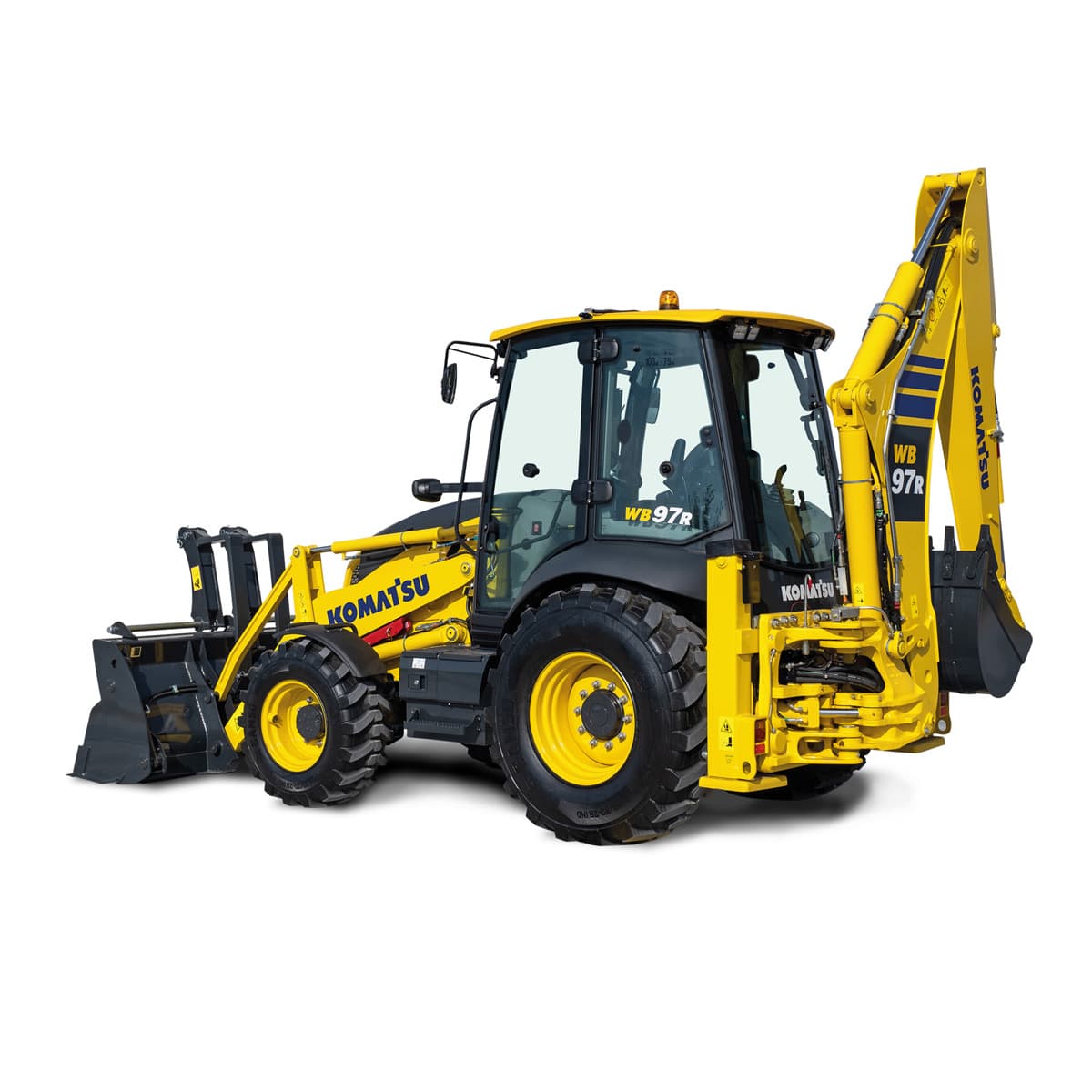
A backhoe loader is three machines in one. At the front, a loader: front bucket, lift arms and their cylinders. In the middle, a wheeled tractor: engine, transmission, axles and the cab, with a seat that swivels to face either end. At the back, the backhoe: two stabilizers that plant the machine on the ground, the swing frame, the boom, the dipper and the backhoe bucket, all moved by hydraulic cylinders. The parts changed most often are wear parts —teeth, cutting edges, pins and bushings—, tires and filters.
The three sections of a backhoe loader
Thinking of it front to back helps you name any part: what loads, what moves it and what digs. The operator works one end at a time: facing forward to load and drive, and swiveling the seat to the rear to dig.
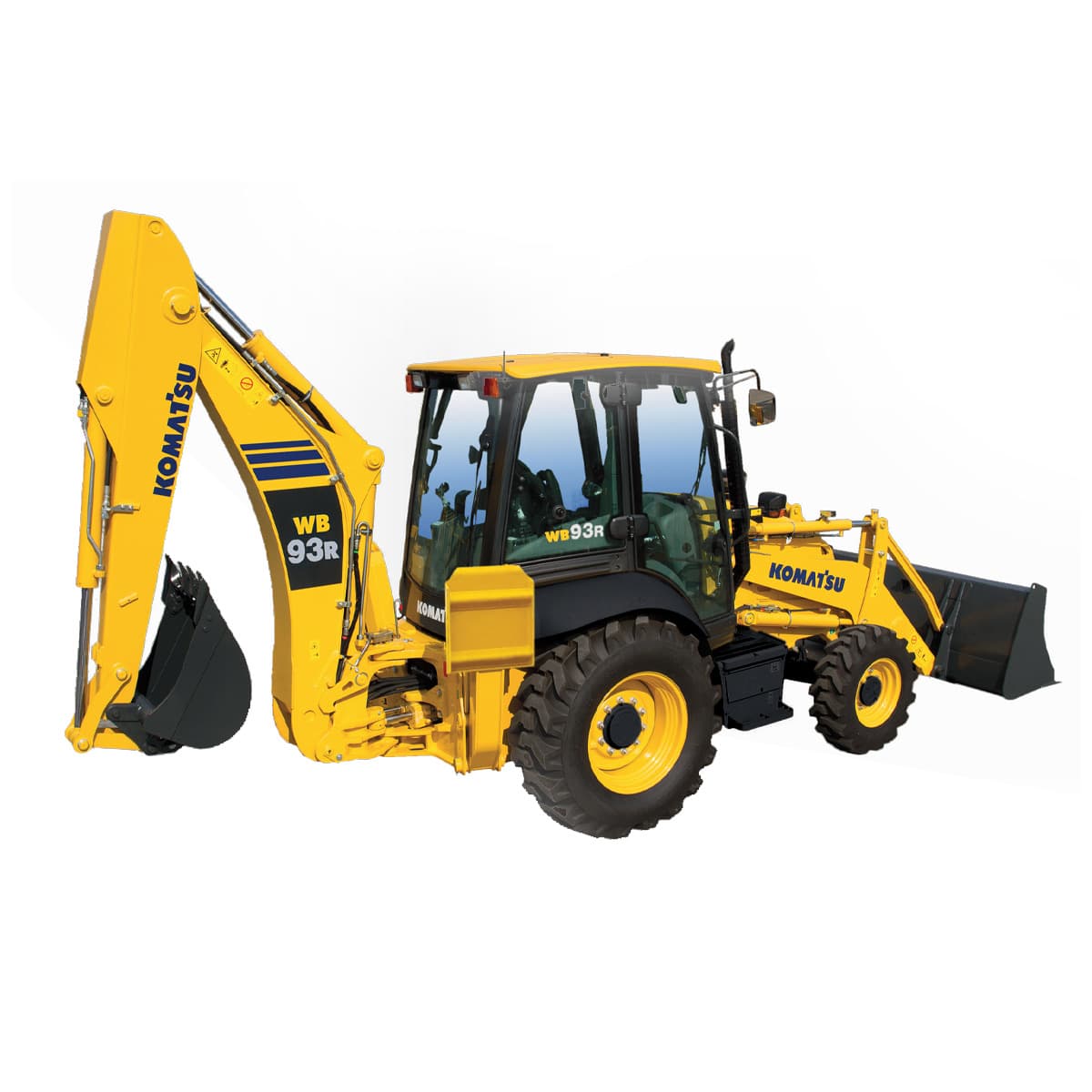
- Loader (front): Front bucket, lift arms, lift and tilt cylinders
- Tractor (middle): Cab with swivel seat, engine, transmission, axles and tires
- Backhoe (rear): Stabilizers, swing frame, boom, dipper, backhoe bucket and cylinders
Front: the loader
The loader loads trucks, backfills trenches, moves material around the site and cleans up. The front bucket rises and lowers with the lift arms, driven by the lift cylinders, and tilts to fill and dump with the tilt cylinders. On the Komatsu WB93R-5E0 and WB97R-5E0 backhoes the standard front bucket is 1.03 m³, per their datasheets.
On the bucket, the cutting edge and, if fitted, the teeth wear out. The arm joints use pins and bushings, greased as the manual says.
- Front bucket: loads and dumps; its capacity is on the datasheet in m³.
- Lift arms: raise and lower the bucket.
- Lift and tilt cylinders: raise the bucket and tilt it.
- Cutting edge and teeth: the bucket's wear parts.
- Pins and bushings: the joints; they get greased.
Middle: the tractor and the cab
The tractor is what lets the backhoe drive itself between nearby work fronts, without a lowboy: diesel engine, transmission, axles and tires. Both Komatsu backhoes in the catalog have four-wheel drive and a 74 kW (99.2 HP) engine, per their datasheets; that power is rated to ISO 14396, which gives gross power.
The cab is two workstations in one: the driving and loader controls face forward, and the backhoe controls face the rear. The seat swivels to go from one to the other. That's also where the dashboard, the data plate and, on the Komatsu line, KOMTRAX are.
The hydraulic pump, driven by the engine, supplies the pressurized oil that moves every cylinder; on these two backhoes, up to 165 l/min per their datasheets.
Rear: the backhoe and the stabilizers
Before digging, the two stabilizers come down: hydraulic legs on each side of the rear end that plant the machine on the ground so it doesn't move or rock while digging. On the Komatsu WB93R-5E0 and WB97R-5E0 they're X-type, with pads, per their datasheets. Together with the front bucket resting on the ground, they keep the backhoe steady.
The backhoe is a digging arm smaller than an excavator's: the boom comes out of the swing frame, the dipper attaches to its tip and the backhoe bucket cuts the material. It all sits on the swing frame, which moves the arm from side to side behind the machine: 180° on both Komatsu backhoes, per their datasheets. Unlike an excavator, the backhoe doesn't swing 360°. Its downward reach is measured as digging depth: the maximum is 4,977 mm on the WB93R-5E0 and 5,270 mm on the WB97R-5E0, and the optional telescopic arm reaches deeper, per their datasheets.
- Stabilizers: the two legs that support the rear end while digging.
- Swing frame: moves the backhoe from side to side.
- Boom: the first section of the digging arm.
- Dipper (or stick): gives reach and depth; a telescopic dipper is optional.
- Backhoe bucket: cuts and loads; the standard one on both Komatsus is 0.19 m³, per their datasheets.
- Boom, dipper, bucket and swing cylinders.
- Teeth, pins and bushings: what wears most on the backhoe.
- How do you choose a backhoe loader for your jobsite?
- Mini excavator or backhoe loader: which one is right for you?
How to order the right part
With the right name you're halfway there; the other half is identifying your machine. Send the full model and serial number from the plate, a photo of the old part and its part number if you can read it. Also say which end it goes on: a loader pin is not a backhoe pin, and a left stabilizer cylinder is not a right one.
Grupo ConstruMarket quotes genuine Komatsu parts and wear parts in all four countries; at /repuestos you can search by part number.
- Genuine or aftermarket parts: which makes sense and what to check?
- What are the parts of an excavator and what does each one do?
Summary: what to choose
| If… | Then… |
|---|---|
| The part is at the front and moves the big bucket | Loader: front bucket, arms, cylinders |
| The part drives the machine or sits in the cab | Tractor: engine, transmission, axles, cab |
| The part is at the rear and digs | Backhoe: boom, dipper, bucket, swing |
| The part steadies the machine while digging | Stabilizers |
| You're ordering the part | Model + serial + photo + which end it goes on |
Get a quote without leaving
Want to work it out with an advisor?
Topic: Backhoe loader parts
Which country is your project in?
Common mistakes
Digging without lowering the stabilizers
The machine moves, the cut comes out crooked and the pins take every jolt.
Asking for “the backhoe cylinder” and nothing else
There are boom, dipper, bucket, swing and stabilizer cylinders, and they change between serials: send model, serial and a photo.
Greasing only the end you use most
The loader and the backhoe each have their own joints: both ends get greased.
Driving with the front bucket loaded and high
It raises the center of gravity and blocks the view: travel with the bucket low.
Take it to the job site
Print the checklist to go over it on site, or send the guide to your crew.
Book a workshop service for your Komatsu or Bobcat
250, 500 or 1,000-hour maintenance, a fault or an inspection. Suggest the day and the workshop confirms your appointment.
Frequently asked questions
What are the parts of a backhoe loader?
Three sections: the loader at the front (front bucket, lift arms and cylinders), the tractor in the middle (engine, transmission, axles, tires and the cab with a swivel seat) and the backhoe at the rear (stabilizers, swing frame, boom, dipper, backhoe bucket and cylinders).
What are a backhoe loader's stabilizers for?
They plant the rear of the machine on the ground before digging, so it doesn't move or rock while digging.
Does a backhoe loader swing 360° like an excavator?
No. The swing frame moves the arm from side to side behind the machine —180° on the Komatsu WB93R-5E0 and WB97R-5E0, per their datasheets— but it doesn't turn all the way around. If the job needs 360° swing, the machine is an excavator.
Which backhoe loader parts wear most?
The teeth and cutting edges of both buckets, the pins and bushings of the loader and backhoe joints, the tires and the filters, which are changed by hours.
What is the rear part of a backhoe loader called?
It's the backhoe or digging arm: boom, dipper (stick) and backhoe bucket, mounted on the swing frame and steadied by the two stabilizers.
Ready for the next step?
Find a part by part numberGrupo ConstruMarket · Job site checklist
What are the parts of a backhoe loader and what does each one do?
A backhoe loader is three machines in one. At the front, a loader: front bucket, lift arms and their cylinders. In the middle, a wheeled tractor: engine, transmission, axles and the cab, with a seat that swivels to face either end. At the back, the backhoe: two stabilizers that plant the machine on the ground, the swing frame, the boom, the dipper and the backhoe bucket, all moved by hydraulic cylinders. The parts changed most often are wear parts —teeth, cutting edges, pins and bushings—, tires and filters.
Front: the loader
- Front bucket: loads and dumps; its capacity is on the datasheet in m³.
- Lift arms: raise and lower the bucket.
- Lift and tilt cylinders: raise the bucket and tilt it.
- Cutting edge and teeth: the bucket's wear parts.
- Pins and bushings: the joints; they get greased.
Rear: the backhoe and the stabilizers
- Stabilizers: the two legs that support the rear end while digging.
- Swing frame: moves the backhoe from side to side.
- Boom: the first section of the digging arm.
- Dipper (or stick): gives reach and depth; a telescopic dipper is optional.
- Backhoe bucket: cuts and loads; the standard one on both Komatsus is 0.19 m³, per their datasheets.
- Boom, dipper, bucket and swing cylinders.
- Teeth, pins and bushings: what wears most on the backhoe.
Avoid
- Digging without lowering the stabilizers. The machine moves, the cut comes out crooked and the pins take every jolt.
- Asking for “the backhoe cylinder” and nothing else. There are boom, dipper, bucket, swing and stabilizer cylinders, and they change between serials: send model, serial and a photo.
- Greasing only the end you use most. The loader and the backhoe each have their own joints: both ends get greased.
- Driving with the front bucket loaded and high. It raises the center of gravity and blocks the view: travel with the bucket low.
Job site:
Date:
Supervisor:
Scan it for the full guide, with video and FAQ
https://grupoconstrumarket.com/en/guias/partes-de-una-retroexcavadora-y-para-que-sirve-cada-una