

Short answer
Greasing right means lubricating each point with the product, quantity, machine position and interval your model's manufacturer calls for, with the machine shut down and secured. There's no universal number of pumps or a grease that works for everything: the guide is your machine's lubrication sheet, which the workshop builds from the manual. A dry point silently wears the bushing and the pin; an over-greased one blows seals. Both are avoided with method.
Why daily care matters so much
On a construction machine, the pins and bushings of the boom, arm, bucket and joints work under load, dust, mud and water all day. Grease does two jobs: it keeps a film between metal and metal, and it pushes out the dirt and water that get into the joint. When it's missing, wear gives no warning: first the bushing opens up, then the pin goes oval and, if it continues, the boom bore gets damaged. At that point the repair is no longer a grease fitting but workshop time, parts and days of downtime.
Daily care is also safety: a pin with play, a missing retainer or a leak nobody saw are the faults that end in accidents. And it's money when you sell or trade in: a machine with its greasing and inspection history shows how it was looked after. If your equipment is under warranty, check its terms: maintenance per the manual and its records are usually part of them.
Before greasing: the machine, secured
Most maintenance accidents happen when approaching a machine that can move or that still has stored energy. Before touching a grease fitting:
- Park on firm, level ground, away from traffic and edges; brake applied, controls in a safe position and wheel chocks if needed.
- Lower the bucket, blade or forks to the ground. If the manufacturer calls for another position to reach a point, follow it before shutting down.
- Shut the engine off and take the key: nobody starts it while you grease. To enter danger zones, lock out energy per procedure.
- Release hydraulic pressure only with your model's procedure: shutting the engine off doesn't remove all pressure.
- If a point needs the arms raised, use the approved mechanical support; on articulated machines, fit the articulation lock. Never use a hydraulic cylinder as a support.
- Let it cool down. Proper glasses, gloves and footwear; always climb up and down with three points of contact.

Each machine's lubrication sheet
Each machine, with its serial number and attachments, needs its own sheet. The workshop identifies each point on a photo or diagram and gives it a code (G01, G02…). With that sheet, the operator doesn't guess: they know what to grease today, with what and how much. Copying another model's sheet is one of the most expensive mistakes.
- Component and point code (G01, G02…), with a photo of where it is.
- Lubricant approved by specification, not by color or by the brand on the bucket.
- Quantity or fill criterion, and whether the manufacturer calls for purging.
- Interval: by hours, by calendar or by severe service.
- Machine position and safe access to that point.
- Sealed points that are NOT greased and points fed by the automatic system.
- Reference to the manual page each figure comes from.
Step by step, at each point
With the machine secured and the sheet in hand, each point follows the same sequence. Greasing slowly and cleanly is worth more than greasing a lot.
- Confirm on the sheet: Is it due today? Does the automatic system feed it?
- Right grease: By specification; labeled gun
- Clean: Gun, hose, coupler and fitting
- Apply slowly: The amount on the sheet
- Purge only if stated: Not at every point
- If it won't take it, stop: Report it; don't force it
- Clean and log: Excess, seals, points done
How much grease: neither dry nor bursting
A pump stroke isn't a measurement: every gun delivers a different amount. If the sheet states grams, measure how much your gun gives per stroke and calculate with that figure. Where there's no quantity, the manufacturer sets the criterion.
The habit of greasing «until it comes out everywhere» only applies where the manufacturer calls for purging an open pin-and-bushing joint. On bearings and sealed points, excess grease lifts or breaks the seal, and that's where dirt gets in later. If a point won't take grease, resistance jumps, it leaks at the coupler or the fitting is damaged: stop and report it. Raising the pressure or taking things apart to force it through ends in bigger damage.
Points that aren't routine greasing
Some points look like grease fittings and aren't, or they have their own procedure. Mixing them up damages the machine or hurts someone.
- The track adjuster holds high-pressure grease to set the tension: it isn't a greasing point. Only trained staff touch it, with the model's procedure.
- The swing ring and gear have their own instructions; don't assume they're greased daily.
- Sealed points take no grease: log them on the sheet as «sealed».
- Forklift and telehandler chains use their own lubricant and method; they aren't swapped for pin grease.
- Plate compactors and rammers with oil baths or closed systems take no extra grease.
- Hydraulic breakers use special grease for the tool and their own frequency, different from the carrier machine's.
Where to look by type of equipment
This isn't a greasing map: these are the areas where each family's points usually are. The exact points, product and interval come from the model's and attachment's manual.
- Excavators and backhoes: boom, arm, bucket and linkage pins; blade or outriggers if fitted.
- Skid steers and loaders: arms, cylinders and coupler per the map; check the coupler lock.
- Articulated loaders: center articulation, axles and driveline; articulation lock to work there.
- Dozers and motor graders: blade, ripper, circle and joints per the model.
- Rollers and compactors: articulation, drum, scrapers and vibration isolators; exciters may use oil, grease or be sealed.
- Forklifts and telehandlers: forks, mast, chains and retainers.
- SIMAQ plate compactors and rammers: engine oil, bellows, shoe and vibrating element per their design.
- Generators and light towers: fluids, visible wiring and mast; anything electrical, only competent staff.
If your machine has automatic greasing
An autolube system distributes grease through lines from a pump with a reservoir, but it doesn't look after itself. In the daily inspection, check the reservoir level, the alarms, that lines aren't broken or loose and that there's fresh grease at the points it feeds. Don't double up by hand at those points unless the manual says so, and grease by hand the ones the system doesn't cover. Grupo ConstruMarket installs this system as a special solution.

Water, mud, dust and severe service
If the machine works with water, mud, extreme dust, impacts or heavy breaker use, the normal interval may not be enough. Ask the workshop for a plan adjusted to severe service, written on the sheet; don't make up intervals.
Washing isn't lubricating. After washing or working submerged, follow the manufacturer's instructions. Keep the pressure washer off seals, radiator fins, connectors and sensors, and don't use compressed air on filters unless the manufacturer allows it.
The right grease
Grease is chosen by the specification the manual calls for (consistency grade, thickener, temperature and additives), not by color. Don't mix greases with different thickeners without approved compatibility: they can soften and stop protecting. Use labeled guns, one per product, and clean, identified containers.
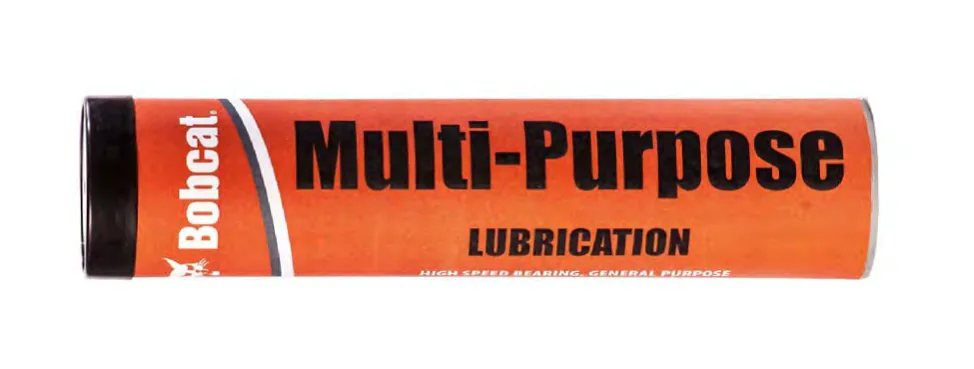
As a reference, the Bobcat 6903122 multi-purpose grease in the catalog is NLGI 2 lithium complex, for –20 °C to 160 °C; use it where your machine's manual calls for that specification. At the branch and on the parts page you'll find genuine greases and lubricants from the brands we represent.
Grease injection: a medical emergency
High-pressure grease or oil can go through the skin through a hole so small it looks like a pinprick. That injury is serious even if it doesn't hurt at first. If it happens, stop work and go to the emergency room right away; say it may be a high-pressure fluid injection and which product it was. Don't wait for pain or swelling to appear. For the same reason: never look for hydraulic leaks with your hand or loosen fittings to check pressure.
Summary: what to choose
| If… | Then… |
|---|---|
| You're about to grease | Machine secured, key out, sheet in hand |
| You don't know how much grease it takes | The workshop sheet says; a pump stroke isn't a measure |
| The point won't take grease | Stop and report it; don't force it |
| It's the track adjuster | Not greasing: trained staff only |
| It works in water, mud or extreme dust | Workshop's severe-service plan |
| High-pressure grease pierced your skin | Emergency room right away |
Get a quote without leaving
Want to work it out with an advisor?
Topic: Greases, lubricants and service
Which country is your project in?
Common mistakes
«The same grease for everything»
Pins, bearings, breakers and automatic systems may call for different products.
«Until it bursts or comes out everywhere»
Excess breaks seals; respect each point's quantity and criterion.
Mistaking the track adjuster for a fitting
It holds high-pressure grease for tension; touching it without procedure is dangerous.
«The automatic one greases itself»
Check reservoir, alarms and lines every day; an unfed point dries out just the same.
Greasing with someone moving the machine
If a point needs a maneuver, follow the manufacturer's procedure with authorized staff.
Copying another model's sheet
Each serial and attachment has its points; a copied sheet leaves points dry.
Book a workshop service for your Komatsu or Bobcat
250, 500 or 1,000-hour maintenance, a fault or an inspection. Suggest the day and the workshop confirms your appointment.
Frequently asked questions
How often is an excavator greased?
Your model's manual states it, by hours or by calendar; if it gives both, whichever comes first applies. Many boom, arm and bucket points are often due every shift, but your machine's sheet rules, and severe service can shorten the interval.
How many pumps of grease does each point take?
There's no universal number: every gun delivers a different amount per stroke. Use the quantity or criterion on the lubrication sheet and, if it's in grams, measure what your gun gives.
Can any grease be used?
No. It's chosen by the manual's specification, not by color, and greases with different thickeners aren't mixed without approved compatibility.
What happens if I over-grease?
On bearings and sealed points, excess lifts or breaks the seal and lets dirt and water in. You only purge until fresh grease shows where the manufacturer says so.
Who builds my machine's lubrication sheet?
The workshop, with the model's current manual, the serial number and the attachments you use. Grupo ConstruMarket's after-sales team can help you build it for your fleet.
Ready for the next step?
Ask for your machine's lubrication sheet