
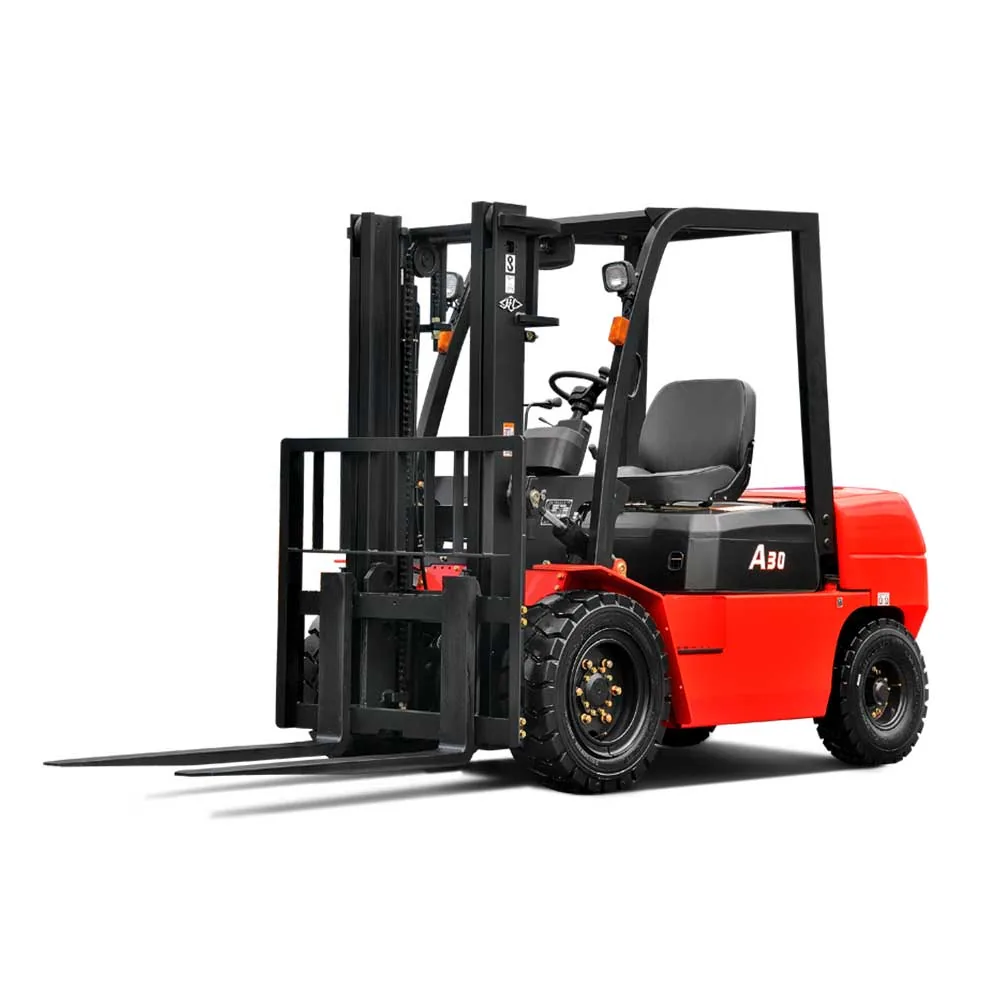
They get mixed up because both «lift things», but they're built for different jobs. A forklift is a warehouse and yard machine: it raises, lowers and stacks pallets precisely, many times a day. A skid-steer is a jobsite machine: it loads, pushes, digs and cleans, and with attachments does the work of several machines. Choosing wrong is expensive: a skid-steer can't safely stack at four meters, and a standard forklift doesn't work on loose dirt.
What each one does
Forklift: forks on a mast that raises the load several meters, counterweight at the back and rear-wheel steering to maneuver in aisles. Its job is moving and stacking pallets on firm floors. Skid-steer: a compact machine with lift arms at the front and a coupler for a bucket, forks, breaker, broom or auger; it turns on its own axis and works on dirt, gravel and debris. Its job is moving bulk material and doing several tasks on the same site.
When a forklift
Warehouses, distribution centers, material yards and factories: when the job is receiving, putting away and dispatching pallets all day, and stacking them in racks. There are versions for each environment: electric for smoke-free indoor work (now with fast-charge lithium batteries), combustion for outdoor yards and long shifts, rough-terrain for dirt yards and sites, reach trucks for narrow aisles and tall racks, and explosion-proof for areas with flammable gases or dust.
When a skid-steer
Construction, site development, maintenance, farming and cleanup: when you need to load dirt or gravel, grade, clear debris, dig trenches or holes and move material in tight spaces. Its strength is swapping attachments in minutes. With forks it can move the occasional pallet in a yard, but it doesn't replace a forklift in a warehouse: it lifts lower, with less precision and limited visibility toward a raised load.
The third option: telehandler
If on site you need to lift material onto a slab or a second level and also carry it over rough ground, neither one reaches: that's where the telehandler comes in, combining a site machine's traction with a boom that reaches high and forward. It's common in vertical construction, agricultural storage and structural assembly.
How to decide in three questions
Where does it work? Firm floor indoors, forklift; dirt or gravel, skid-steer or rough-terrain forklift. What does it move? Pallets and packaged loads, forklift; bulk material and varied tasks, skid-steer. How high? Stacking in racks or onto a tall truck, forklift; lifting to site levels with reach, telehandler. If the answers are mixed, many operations end up with both: the forklift in the warehouse and the skid-steer in the yard.
Get a quote without leaving
Want to work it out with an advisor?
Topic: Forklift or skid-steer
Which country is your project in?
Frequently asked questions
What's the difference between a forklift and a skid-steer loader?
A forklift lifts and stacks pallets high on firm floors (warehouses and yards). A skid-steer loads, pushes, digs and cleans on site, and switches tools with attachments. One is for load handling; the other for moving material on site.
Can a skid-steer with forks replace a forklift?
For the occasional pallet in a yard, yes. For a warehouse receiving and stacking all day, no: a forklift lifts higher, more precisely and with better visibility, and maneuvers better in aisles.
Electric or combustion forklift?
Electric for indoor work and shifts that allow battery charging (no fumes, less noise and maintenance). Combustion for outdoor yards, ramps and long shifts without charging stops.
What forklift capacity do I need?
That of your heaviest load, with margin. Note: rated capacity is measured at a given height and load center; lift higher or carry a longer load and real capacity drops. Check the unit's load chart with an advisor.
Ready for the next step?
Get a quoteMore guides
- How to choose an excavator for your project
- Rent or buy machinery: how to decide
- Preventive maintenance: protect your investment
- How to choose machinery for mining
- Machinery financing and leasing: how to choose
- How to choose a skid-steer loader (radial vs. vertical)
- What to check before buying used machinery
- How to calculate your machine's cost per hour
- How to choose your excavator bucket
- How to choose a wheel loader
- How to choose a motor grader
- Filters and wear parts: warning signs and when to replace them
- How to choose an electric generator for your jobsite